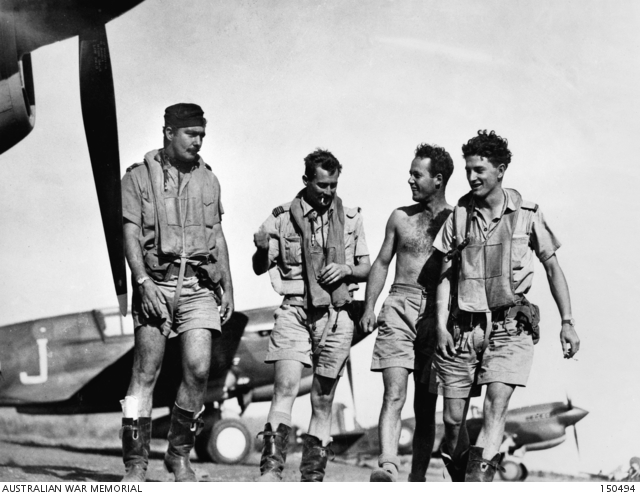
Port Moresby, New Guinea. August 1942. Kittyhawk fighter pilots of No. 75 Squadron RAAF, during a break in operations against the Japanese.
Port Moresby, New Guinea. August
1942. Kittyhawk fighter pilots of No. 75 Squadron RAAF, during a
break in operations against the Japanese.

Transcript of Australian War
Memorial recording https://www.awm.gov.au/collection/S00701/
.
This historically-important interview has been placed here so that
its content is searchable for 3SQN Website readers.
[WORKING VERSION
- Currently being edited by 3SQN Assn for readability and spelling
of technical terms.]
TRANSCRIPTION COVER SHEET
INFORMANT: ARTHUR TUCKER
INTERVIEWER: Ed Stokes
SUBJECT OF INTERVIEW: 75 Squadron, RAAF
DATE OF INTERVIEW: June 1989
TRANSCRIBER: Margaret Sparke
TRANSCRIPTION DATE:
29 June 1989
Tape identification: This is Edward Stokes recording with
Arthur Tucker, 75 Squadron, Tape 1 Side 1.
Arthur, can we just go back to the beginning? Could you
tell us where you were born, and when, please?
On 1st March 1920 I was born in Brisbane, and my mother
was widowed when I was nine months old, a car accident. And she then
returned to the country to family members, subsequently married in the
country, and I lived with her and my stepfather until I was about
eight, up in the Brisbane Valley at Esk. So I was a country boy till I
went to Brisbane for the rest of my education, stayed with my
grandparents until I completed my Intermediate - it was called the
Queensland Junior Public - at the age of fourteen. Then I took up ...
this was the end of the depression, jobs weren't easy to come by, and
I took a teacher training course with the Queensland department. And
by the time I was sixteen and a half, I was judged to be mature enough
to become a fully fledged country school teacher, which I did in a
little town forty miles north of Mackay. I was there for a year and,
in our discusssions of your own career, you know what a vacancy there
is at the weekends, particularly in country towns.
Now, at that time the government supplied freely .303
rifles and lots of ammunition to rifle clubs, and by the end of that
year I was the district junior rifle champion. The point of this,
which will emerge later when we talk about air combat, rests on my
ability to hit targets at three to five hundred yards over open sights
and with a peep sight up to nine hundred yards. It meant that I knew
range and I knew the capability of a high-powered rifle and had no
qualms about firing it at something at three hundred yards. Later, I
was in charge of country one-teacher schools, down in the Darling
Downs and later in central western Queensland. So that, in this period
- because I joined up when I was twenty, still in central western
Queensland - I had associated with grown men. When I was in the rifle
club at seventeen, I was also playing rugby with cane-cutters. Then in
central western Queensland, when the stations were shearing and
carting their wool, I used to do this for the exercise and association
with other people. And you know that men don't tolerate boys very
well, you learn ... you grow up quickly or they ... you know, that's
it ... so that the old hard knocks really comes into it. By the time I
was twenty I was a big fellow, I wouldn't take any lip from anyone,
and very sure, very independent. That's the sort of thing you
want to know?
(5.00) Yes, that's most interesting. There was
certainly that independence, from some things you were saying before.
Arthur, you did tell me the story of your uncle who was at Gallipoli;
and that, I think, reflects in quite an interesting way on your views
towards the Empire and potential war and so on.
Yes, you were interested in how people like myself saw Australian
ANZACs and others. And, as I told you, he was a good example. He was at
Gallipoli, then he went to France. And you'll surely have
heard of the, you know, the unthinking use of men, quite fruitlessly
in many of those pushes in France; and you probably know that
Australian troops in particular, when they couldn't see the sense of
it, became what was called `mutinous'. Now, they didn't take kindly to
what some of the British troops seemed to be ready to put up with. And
Albert had had a good career, but, by that stage, he was beginning to
see some light at the end of the tunnel, and so he shot off to Ireland
where he met a very nice Irish lass from County Cork whom he married
and brought back to Australia. And if they'd caught up with him before
the Armistice, no doubt the story would have been quite different.
But from people like that, and from ... we had a Church of England
clergyman who used to visit our primary school on ANZAC Day and, looking
back, it was quite amazing the hair-raising stories he used to tell us.
ANZAC Day in those days was a national day of mourning,
no celebration, and so I ... Our family was completely Celtic,
there's no ... it's Irish, Welsh and Scotch, but no ... and with all
the, I suppose, independence, and some anti-monarchist feeling - which
hasn't evaporated, I can tolerate them but, you know, I wouldn't see
any reason for going and doing something silly just because the king
wanted me too. But, you know, Albert served, and his mates, they
served and did the things they thought it was needed for Australia.
They were told it was needed, but they weren't persuaded for any other
reason, and afterwards they did wonder why. Because of the association
with Ireland - and he was there during the black-and-tan business - in
our family there was a lot of resentment of the British attitude to
things. And then later, with the depression and - wasn't it Sir Otto
Niemeyer and the Australians not being forgiven their war debts when
other countries were? - there wasn't any feeling in me right up to the
time I joined that I should do this for any reason other than that our
own country might be under some sort of threat.
Mmm, that's most interesting, Arthur. And during
the period of say the 1930s, the later 1930s, when there were definite
political changes occurring in Europe which some people predicted
would lead to war and in fact occurred under Hitler, - were you
conscious of that? How did you feel about developments in
Hitler's Germany?
Well, just to tell you another thing before I get to the German
incident ... well, take it by incident. I remember when I
was at the Grammar School leading and winning a debate on relations
with Japan. And it's just occurred to me that I was waving a newspaper
of the time which recounted that someone had been in Japan and there
had seen in the schools a map of Australia which he alleged had
written across it `Your future home'. You know, that would be 1934.
But the incident that I think is probably more to the point is that I
was telling you, in previous conversations, that as a country school
teacher one of the problems was dealing with the parents that ... you
know, they were always on the school committee, and you had to appease
them. Now, when I was in ... down in Elbow Valley, on the upper end of
the Condamine, it was a war settle... a soldier settlement area, and
one of the people who ... one of the families that I had associated
with quite closely with, the father had been gassed on the Marne, and
he had very great trouble with his breathing.
(10.00) Now, relations had been very good until I got carried away during a history lesson, and was explaining to the
children that there was a possibility that, had the Versailles Treaty
not been so severe, had Germany not been treated quite so harshly, the
Germans might have been able to order their affairs and choose a more
rational group of people to govern them, because about that time
Hitler was starting to move in on the Sudetenland. And the next
meeting of the school committee I really got torn to pieces by these
people who showed me their various wounds and wheezes and pointed out
that they weren't going to have their children's minds poisoned by
some ... what we'd now call a `trendy', negating everything they had
done. And yet the parallel to that - and I've just been reading
Kristen Williamson's Last Bastion - it appears that even
Menzies, in the period up to the beginning of the war, was unwilling
to send Australian troops overseas until relations with Japan had been
settled. Now we weren't, in training, ever to have anything told us
about Japan, we never had any Japanese aircraft recognition or
anything till we got fired into the battle, there was absolutely no
preparation there at all. And yet it's interesting to find out that in
about 1939 Menzies was so worried about what Japan would do that he
had to have assurances that ... from Churchill that they ... that the
response that we'd get ... and this was all because Menzies himself
recognised that the western countries were pinching Japan very
severely in trade, on rubber, and oil. And so that, in a way here too,
you're getting the situation ... and people don't realise how trade
... how dangerous trade wars are, and yet it's going on today, with
American wheat isn't it?
Mmm. Yes, that's most interesting. Arthur, just
turning back for a moment to the debating incident - that
anecdote where you were waving the ... this Japanese newspaper with
this Australia marked in as a future home - could you just clarify
that particular point about the newspaper? And also, do you
recall the motion, and on which side were you speaking? And did
you sincerely believe what you were debating, or was it merely a show
debate?
Ah, I tend to believe what I say (laughing). I ... oh well, I suppose I was young, you know, one wants to win a debate.
But I think it was some ... I ... just the ... you know, it sort of
just flashed into my mind. I've only just recalled the incident; but I
think it was a debate in which it was put that there was no threat to
Australia in the foreseeable future. And this was 1934, and of course
it was by that time obvious that the Japanese were starting to tread
heavily on the Chinese; and I think the debate was that we couldn't
feel sure that Japan wouldn't take further interest. In fact, I was
proving to them that this fellow had seen evidence that they did
think of Australia in much the same way.
As
a potential ... ?
As a potential source of room. The very thing they're doing now, but
they're buying the place up instead of taking it. That's
half joking, you know; but still, we've got those concerns, we can ...
you know, every nation looks to its borders.
Yes, well that's certainly true. And certainly, looking
at the contemporary scene, I think that's certainly a very general
comment.
Could I add to that? - because we were talking before, and I think
maybe you were trying to gauge whether I ended up by joining up because
it was an empire, a nationalistic thing, that I believed in. And I
think, no; I think my concern, and the concern of a lot
of people who having been brought up rather pacifistically did join
up, was that, although we weren't told as much as could have been told
us about the gathering storm in the East, we still didn't feel happy
with our situation with England apparently being close to going to the
wall.
Mmm. Yes, that's most interesting. Pacifism I guess
often breaks down in the reality.
When you're threatened.
Mmm. My father was, actually. And he joined up shortly
after the beginning of the war. I mean, he was a pacifist. Well, let's
move on a bit. I think you were about twenty when war broke out. Do
you actually recall the declaration of war on Germany by Britain?
Yes, I do. I was in this ... This little fettler's camp was a place called Yalleroi, and it had been a staging post for Cobb and
Co., and there was a little old country store-cum-hotel where I used
to board, close to the school. Well, there was only half a dozen
buildings in the whole place. And I can remember sitting with old
Macdonald, who ran the place, listening to his radio one evening, and
hearing it all. I can remember it quite distinctly.
(15.00) And how did you feel? What were your thoughts?
Ah, oh, it seemed omin ... I felt ominous, sad about it, it was something that really it did weigh on me because, as I told you,
in my upbringing there was such a lot of discussion. ANZAC Day was
always a day of quite deep national mourning in those days. People
nowadays wouldn't have any idea quite what a ... ah, what a burdensome
day it was. Of course, Australia had lost a whole generation of young
people, and they were being missed. There were quite an excess of
unmarried ladies who had either lost fiances or who had grown up in a
land which had been bereft of its young people.
That's most interesting, Arthur. Moving on a little bit,
it was shortly after that that you applied to join the air force but
of course had to wait, as many people did, for some months before you
were in fact called up. Why the air force?
I was interested in flying always. I was at Ascot
aerodrome when Hinkler landed there in 1928. I was down at Pinkenba
when Kingsford Smith and Ulm landed there. I think I was about ten
then. I read books about aeroplanes and made models.
Was there ever any thought of the other services? Or was
it the air force or nothing?
No, well, what ... I decided I'd want to do something technical. If the
air force wouldn't have me, I was going to join an artillery ... ah, I
didn't ever think of joining the navy (laughing).
They're
not technical? (laughter)
Ah no, I got ... it's just that it never occurred to me.
No, I was just thinking it's funny how people see
things.
I lived too far from the coast, I suppose. (laughter)
Yes, well that's certainly understandable. Uhm, let's go
on then. I think it was in ... about Christmas 1940 you were called
up.
Mmm.
You
went to Bradfield Park.
Yes.
You were obviously something of a loner, if not a rebel
...
Mmm.
... and you were thrown into a situation that was
obviously highly structured and hierarchical, service situation. How
did you react?
Oh, I enjoyed my training. I've read recently someone writing about the
many privileges that air force pilots had had in training, the sort of
life of milk and honey, sort of like gladiators being prepared for the
fray - well it was nothing like that. That's erron... a
romantic view of what it was. But it was a most inspiring and
interesting thing, right through from the time the ground lectures
started. And of course the physical training was enjoyable,
navigation, all those things. I was always a dab hand at arithmetic,
so navigation ... the only thing I couldn't stand was wireless
telegraphy. No, that was ... but I'd have been quite happy as a
navigator if they'd scrubbed me as a pilot.
Mmm. And what about the drill aspect of your early
training, which was obviously quite strong? Do you see a direct
correlation between that kind of instinctive discipline and later
flying aircraft? Or was it unnecessary?
The drill, you say? Oh well, one needed to be fit. And of course out
in, you know, in the country and that, I'd had more than
my quota of beer with the men and I needed a bit of fitness and ...
no, I enjoyed that greatly. And even the WOD was a tall, lanky fellow
at Bradfield Park who used to ... oh, he put on a magnificent act, you
know, he was a ... and I could see ... But I used to have
troubles with some of the drill instructors, I was ... you know they
... when they leant on me, I used to tend to squeak. And actually, as
I told you, I ended up my course by being commissioned off course, and
I attribute a lot of that to the cheek I used to give the drill
instructors (laughing). But it was all in good fun and ... but no, I
had an instinctive dislike of automatic rote-like discipline. But I
could appreciate the good effect it had.
(20.00) Mmm, that's very interesting. I'll ask you
in a moment, Arthur, about the later, more important, stages of
training at Tamworth and Deniliquin. But perhaps just generally
looking over the whole period of the different camps, Bradfield and on
to Deniliquin. Living conditions you've implied weren't champagne and
breakfast in bed. But how tough were living conditions, housing, food,
messes, those things?
Well, we were fed very well at Bradfield Park, and we were working so
hard we needed it. At Tamworth it was delightful, a
lovely little country town. It was winter, which made it hard when you
went flying in a Tiger Moth and your instructor insisted on your
wearing sandshoes rather than flying boots because you were too heavy
on the rudder, because it was a very, very cold place. But at night it
was delightful, we had a big ... we had a pot-bellied stove at the end
of the hut, and we were fed well, and it was a lovely little town
where the townsfolk took a great interest in their little aerodrome.
And I played hockey there for the station. And we occasionally went
off to Armidale and then we'd go into the Royal Hotel and they had a
great big ... you know, wooden fireplace. And the whole thing, I
remember it now with nostalgic feelings, it was a lovely place. No, it
was a number one way of living.
I might say that Deniliquin was a little bit different. We were the
first course to go into Denny and they only had a few of the hangars
complete, and I think we occupied the first two or three huts, and the whole place was a bog. And there was a food mutiny there,
because we got tired of eating mince. The messing wasn't that good. We
used to enjoy night flying; because, after night flying, which was
another delightful experience, we could go up and they'd leave eggs
and ham and toast and cheese, and you could have your night-flying
supper which was always looked forward to with great anticipation.
That was very good.
That's lovely. Just a moment. Well, just going on,
Arthur. Your first actual flying was in Tiger Moths I think at
Tamworth.
Yes.
How was it to fly? You'd looked forward to it. Did
it live up to its expectations?
Oh yes, oh they're splendid. The Tiger Moth was an
experience that everyone agrees is the absolute spirit of flying.
Probably sail-plane enthusiasts would disagree; but with the Tiger
Moth you've got something where you're just with the elements. They
were a delightful aeroplane. Of course, there was a great deal of
trepidation to start with, and that was enhanced by the smell of the
dope and the oil, and then the trembling little fuselage, and the cold
feet that I mentioned, because of the high altitude of Tamworth in the
winter weather we used to get very, very cold.
I had a charming instructor, Mort Brand, who was very, very patient and
considerate and who was a great enthusiast for instrument flying, which
was to be very important to me later. And it was then, because I had ...
amongst my early experiences was watching the Sunderlands
on the Empire route coming into Brisbane. I could stand on our front
verandah and watch them coming in on to the Hamilton Reach. And I ...
of course, 10 Squadron had early on got quite a bit of publicity and
I'd ... I said I didn't want to join the navy but, strangely enough, I
did want to fly a Sunderland on Coastal Command, somehow or other that
really got me, they were such majestic aircraft, and so I wanted to
fly Sunderlands; and I suppose we'll come in a moment to why I didn't.
But the Tiger Moth was ... I supp... it would be like young men like
to get out on motor bikes. It's got, you know, it's ... it's ...
you're free, you're part of nature.
(25.00) I remember the terror the first time Mort slow-rolled
it; and of course you hang up on your straps, you've just got these
two straps over the shoulders, and your feet come off the rudder and
go up behind the instrument panel, and hang on to the side like grim
death, and you have to learn that it's all right, that if you sit the
right way, everything will stay in place when you're upside down.
Yes,
it'd be an awful feeling: what if a strap breaks?
Yes, well that's right. One character that you'd be interested in was
our ... my flight commander then was [Jerry?] Pentland,
who had been written up in the first world war as the wild Australian
war bird. And of all the dreadful things that could happen to you,
just two weeks short of completing my two months on Tigers and passing
on to service flying training, I got mumps. And there I was in
hospital with that dreaded character, the military policeman, who also
had the mumps, and turned out to be a very nice fellow. And when I
came out I was very anxious not to be left behind; and there was only
one instructor pilot on the site, or on the station, who'd fly with me
and that was Jerry. But he came over, having instructed the ground
staff to take my Gosport tube out - you know, in those days you talked
into the end of a bit of garden hose and it came back and plugged into
a couple of tubes that went up to your ear pieces - so he could talk
to me but I couldn't talk back to him because he'd taken away this
source of germs. And he got in - and I suppose Jerry in those days
must have been, what, mid-forties - and he looked round in a trembling
voice and sort of said `Well boy, you keep a good lookout because I
don't see so well.' (a chuckle) So, Jerry, I have to thank him for the
fact that I remained on 13 Course. He did my last ten days flying with
me and I left the station a bit after the others. And we had been all
Queenslanders up till that point, but four of us were sent off to
Deniliquin where we met a lot of Victorians, who play that weird sort
of football they have down there, and the others went off to other
places.
Mmm, that's most interesting. Could I just ask you about
the move to Deniliquin, Arthur. You've said you wanted to fly
Sunderlands; but in fact you were sent off to train on Wirraways. Were
there any objective criteria used by the air force, do you think, in
making those decisions? Or was it very subjective and very personal?
Oh, it was a very highly technical choice. They sat you down with your
back to the wall and measured the length of your legs, and if they were
long enough to fly a Wirraway that's where you went. Mine just made it -
unfortunately, because there was a great deal of gossip
and concern about the vicious flying tendencies of the Wirraway and no
one was particularly anxious to fly them. But, of course, once ...
that meant that you were going on to singles and you automatically
became a fighter pilot, or some such. If your legs were short enough,
which I would have desired, then you'd have ended up on four engines,
either land planes or seaplanes. I must admit the logic of this still
escapes me, that people with shorter legs would handle things like
Lancasters and Sunderlands (a laugh); you know, it doesn't make a
whole lot of sense, does it.
Well, I can't really understand it. I would have thought
you'd just modify the backing of a seat or something to shift someone
forward or backwards.
Well, the thing was that the Wirraway had rudder bars
and incorporated brake pedals, and in order to get full top rudder in
more violent manoeuvres you just had to be able to stretch out and
push the rudder right forward, and you had to have a certain leg
length. But I would have thought it would have turned out the other
way round. But, as we've said, the selection was very arbitrary and, I
suppose, hardly technical.
And there was no ... uhm, for example, rudimentary
psychological assessment of the kind of character which might make a
good fighter pilot or a good bomber pilot?
No. There was no ... not at all. That was the only criterion that
they'd set. They were rather desp... there were too few people
volunteering to go on to them. So that meant that one went off to meet this fearsome Wirraway with, you know, a little bit of
feeling in the water. You didn't feel quite so sure that it was going
to be a welcome experience.
END TAPE 1 SIDE A
BEGIN TAPE 1 SIDE B
Tape identification: Edward Stokes recording with Arthur
Tucker, 75 Squadron, Tape 1 Side 2.
Arthur, could you tell us then about the first
experience of a Wirraway?
Yes, well, we got off the train and we were driven in trucks to this
western town, very taken ... but at that stage they were just developing
the irrigation canals. And then we drove on to this
aerodrome where all the buildings were quite skeletons, there were
only a couple of the hangars that had been fully covered in, and I
think there were only two of the living huts complete, and the place
was very boggy, and we wondered what we'd got to. And the four of us,
meeting all these Victorians ... [Interview continues after a pause]
So there, lined up, in front of these largely incomplete hangars, were
these monstrous looking aircraft - after the Tiger Moth - stubby,
short wheels, and seeming high up and rather ... the short fuselage
made them look almost as though they wouldn't fly, like the bumble
bee. Anyway, with the Wirraway the cockpit was huge after a Tiger
Moth, and you sat up front with your instructor behind, and this
funny, stuttering radial motor when it started up. But I must say I
took to it [interruption] like a duck to water. I found the aeroplane
very easy to handle. I had a - once again - an instructor of my own
ilk who was more interested in instrument flying than aerobatics, and
so I came to be regarded as rather a straight-and-level man when I got
into a fighter squadron.
But of course this had an immense advantage when you ... there was a
belief, widely spread amongst people, that fighter
pilots should be harum-scarum wild men, you know, care about nothing
at all and no ... rather be upside down than right-side up. But of
course the error with that is that if you don't fly smoothly and
instinctively, when you get into combat you'll be slipping or
skidding, and when you press the tit the bullets don't go where you're
aiming, they get thrown off to one side and you won't hit anything.
And you haven't got time to be watching your 'bat and ball' and aiming
at the enemy and pressing the tit. So that in fact if you're an
instinctively smooth flyer there's much more chance you're going to
hit something. So that it really was very important. And of course
when we - we didn't expect to get up to New Guinea, but we should have
expected bad weather over England - but in New Guinea, you just had to
be able to fly on instruments, sometimes when you were in a really
tight corner it was better to try and find yourself a cloud that
didn't have a mountain in it and hide away for a while.
(5.00) Mmm, that's interesting. We'll talk later
about the weather in New Guinea, that was obviously a big thing. Just
perhaps finishing at Deniliquin, Arthur; do you see your training
there as being very effective, quite effective, or not as effective as
it should have been?
Well, I think that we needed it, and in view of how little we were to
get later. The first thing you had to be able to do was to fly an
aeroplane, and that was done extremely well. But of course you did a
little bit of gunnery. From Deniliquin, we got our wings
at the end of two months, and this was hurried forward so that you
could take a passenger, and then we flew over to Port Pirie, and
that's where we did our gunnery against drogues towed by Fairey
Battles. But you were firing with two guns just on top of the motor,
firing through the propellor, two .303, and it was hard to get any
really remarkable scoring on the drogue. You know, if you could hit it
occasionally with these coloured - usually the coloured whole one went
through it - that was fine.
And of course the danger was that in trying to get the sights on the
drogue, if you got around too far you were likely to be shooting out the
back end of the Battle, and they'd be firing off Very lights and - oh,
good fun! But it wasn't the sort of thing that was battle
training or anything like it. And there was formation, but there was
nothing that would ... that was in any way directed toward contact
with the enemy. And I think the comment I would make - I may have made
it earlier on this tape, or in talking to you - now, and reading what
the government had known for some years and Menzies' concern about
Japan, I'm surprised that no one ever talked Japan to us. We never saw
any reports of Japanese aircraft or tactics. I think it is true the
tendency was to try to persuade us they were made of bamboo and
spittle, and that the Japanese were short-sighted and couldn't see at
night. I don't know whether those things were jokes or whether they
were the ... what everyone was trying to believe, or whether somebody
was trying to pull the wool over our eyes; but certainly I never saw
anything technical on Japanese aircraft. And I'll tell you about what
our intelligence officer knew about them later.
Yes, those comments about the Japanese being ineffective
fighters and so on; were they ... do you recall those only in the
context say of drinking, social situations, light hearted banter, or
were the comments such as that ever made more seriously, for example,
by instructors?
It was never discussed by instructors. It was a flying
school. It wasn't warlike training, and there just wasn't any ...
there was no political discussion, there was no tactical discussion,
there was no prediction of what might happen to us, even if we got to
England. It was ... it was cloud cuckoo land, looking back - but it
was lovely.
Well, just turning briefly to two political questions,
then. During that period, despite that lack of ... input, if you like,
from your instructors, were you and your colleagues, and other young
men training, particularly conscious or not of events in Europe? And
also the likelihood of Japan actually entering the war, pre-Pearl
Harbour?
No discussion of Japan at all, no warning, no mention whatsoever. When,
later, Pearl Harbour was bombed, that came as a bolt out
of the blue, there'd never been any mention of it in service areas.
And as for consciousness even of what was happening in Europe, once
1941 was ... we were just floating away flying aeroplanes and enjoying
it, we didn't seem to - oh and listening to Vera Lynn - we never ...
we didn't see any newspapers, we didn't hear any news releases that
... Looking at it now, we were so cut off, I can't believe
it!
(10.00) Yes, it does seem very much like that, very
much in limbo and out of the context of what you were intended to do.
Well, turning to that, I know in January 1942 you went to Nhill in
western Victoria for what was to be an operational training unit; but
I understand your view is that, really, it had very little operational
training input at all.
Yes, well, just to ... probably there's a little bit of a gap there in
that I was commissoned off course, late October, and I was seconded to
the RAF and sent on disembarkation leave and then came back to Bradfield
Park all set to go aboard one of the well known Pacific
ships. We were going to go over through Canada and Halifax to the RAF.
And it was only a couple of days before - we were in Bradfield Park -
in fact, it was within a couple of days of going on the ship when
Pearl Harbour was bombed, and a couple of days later they sent the
first half down, and we were waiting in the afternoon with all our
gear for the buses to come back and take us down, and they came back
fully loaded, and there we were in Bradfield Park for a couple of
weeks. And then, as you say, we were sent off, a few of us, the
Wirraway pilots, were sent off to Nhill, over in the mallee, western
Victoria, where Sammy [Balmer?] was giving a sort of post-graduate
course to a few Hudson pilots, and Jock Perrin was running ... had
some, a few Wirraways there. Well, we did a repeat of the sort of
flying we did in the service flying training on our course. But there
was nothing tactical, nothing much in the way of formation. We did a
bit of bombing and gunnery and a bit of flying in pairs, and that was
it.
So you didn't really gain a lot more than you would have
gained from after the Wirraway period?
Nothing at all, nothing.
Were you disillusioned by that at the time? Or didn't
you realise the import of it?
Well, we didn't know what was going to happen to us. We
knew that Pearl Harbour had been bombed, and we were over there, and
it seemed like a bit of a fill-in, and we'd rather have been flying
our Wirraways than sitting around in Bradfield Park wondering. But,
once again, it was a vacuum thing.
But the period at Nhill, Arthur - at the time, not
looking back on it now - at the time, did you see that as a kind of
pointless vacuum? Or weren't you conscious of the lack of tactical
training, for example?
Well, we didn't know what to expect. Here was a fellow
who'd come back from the 3 Squadron, and he was giving us this. And I
suppose, without voicing it, we wondered what the hell it was all
about. I mean, we weren't learning anything, we weren't being told
anything, we weren't disturbed, we didn't know enough to be frightened
(laughing). But it ... I think I've got to look back, it was so much a
repeat of the comfortable life we'd had and we were still so much
enjoying our Wirraways, that we didn't think another thing about it.
Mmm. There is quite a strong thread running through
things you've already said we'll record later that is certainly
critical of training. Do you think it would be true to say that the
problem was that men who were perhaps great combat fighters themselves
weren't necessarily particularly good teachers of what they themselves
were good at?
Well, I think we'll have to try to get round to some of the things that
we've already talked about; and that is, when you come to the definition
of who is going to do the instructing, and who are the
great combat pilots. You see, you can see now that, here we were in
flying and we'd got into something very comfortable, very pleasant,
and we weren't thinking too much about it. Now, suddenly we're handed
over to some people who've come back from a named squadron and a named
area, whom the government apparently think `Well, these are the people
who can prepare something to go to New Guinea.' But I think you've got
to ... you've got to look at this in hindsight; and that is,
that when you now know what an absolute political, tactical vacuum
there was in our government and our command structure, that they just
didn't know what to do, and they got some people back from an
operational squadron and they said `Ah, we'll put them in charge!
They'll tell us what to do.' Now, without reflecting on anyone, I have
over the years wondered what 3 Squadron were doing, because they were
not doing work that prepared them to pass on anything useful to us
when we came into contact with the Zeros, and what I observed of them,
they didn't know what to do with them themselves.
(15.00) You see, they had been up against ... mostly, I think,
inferior Italian aircraft in inferior Gladiators and things like that;
they were fighting a war almost an extension of world war one. I'm not
being unkind to anyone, but it wasn't ... then they got
the Tomahawks, and I know there were some Me 109s there, but I can't
believe that these people were having a wartime experience that was
relevant to what we were going to have to do. I think they maybe more
have been in close army support, strafing and doing that with the
army, and I'm sure doing a tremendous job. But it didn't have any ...
it didn't prepare them in any way to tell us what to do - with one or
two exceptions, as we'll see.
Mmm, that's interesting Arthur. Do you think perhaps
another aspect of this problem, this difficulty in training, was that
the pilots - the men who trained you - had been fighting against in
Europe German and Italian pilots who thought in a very different way
from the Japanese and were a different sort of enemy?
Yes, that's true. I think the Western Desert was a ... again, it was a
different war. It was a bit like our training, it was ... they were
neither in Europe nor were they over here, they were in the Western
Desert. It ... sometimes, when you read about it, it was
almost a gentlemanly game of tennis, you know. I mean, it was vicious,
people were getting killed, but they weren't doing ... they weren't
facing an enemy as ... as victorious as the Japanese, and then they
weren't even as experienced as the Japanese. See, the Germans, they
did have some people who were very good, they'd been at it ever since
the Spanish Civil War - which incidentally was one of the things that
affected me when I was a young man, that's when I saw that things were
going to have to be done that I mightn't want to do. But the
Japs had been sharpening their claws on the Chinese for six or seven
years, they had the Zero which was a beautiful aeroplane with
tremendous flying capability - poorly armed, fortunately, or I
wouldn't be here - and then they'd pushed everything ahead of them,
they'd just swamped the forces in Malaya and they were on the go.
The people that we were to find in Moresby were some of their very top
men, they were put off carriers there, and they were very experienced and very ... it was something that these other people
hadn't come up against. But there is another thing, and it's got to do
with this whole thing I've been telling you about, about the morale
and the command. I think it was command collapse in Australia
generally. There was tremendous defeatism, in my view, and they didn't
even know whether they were going to put up a resistance. And I think
these blokes back from the Middle East didn't have too much faith in
what they'd be able to do. And, just as we had been told
nothing about the Japs, they hadn't either. They didn't know
what it was going to be about. But also, they hadn't fought a pitched
battle. You see, Moresby, as it turned out was more like the Battle of
Britain than anything else.
Now, the Battle of Britain had been fought a long time
before, and they'd lost a lot of people, and the battle for Moresby
was very much more like that. It was a real pitched-in, hard-going
thing where the Japanese were setting out - in our cases they didn't
have to set out at all the English aerodromes like they did in the
Battle of Britain - but they were set out for Moresby, and they only
had one target and we were sitting on it. And it was an intense effort
so they could invade the place at the beginning of May. And they
wanted to neutralise the place so they could take it over and use it
as a stepping stone. I mean, this is in the history books now. Now,
they hadn't struck anything like that: the Western Desert was a mobile
thing, where they rolled backwards and forwards over the desert and
they used flat areas of desert to land on. We were going to have one
single strip that people could bomb and make parts of it
unserviceable, and there was nowhere else to go. And then, of course,
there was the terrain.
Yes, that's very interesting, Arthur. Could we perhaps
just leave that for a minute, and come back to that in a moment,
perhaps in context. But, going back to the context of the story;
having had this interim period when you might have gone to Britain,
and then Nhill, you then went to Bankstown and that's where you first
encountered Kittyhawks ...
That's right.
(20.00) They were frightening, I think you said, at
first, or they didn't inspire confidence. Could you explain why?
Ah, I think they were awe-inspiring. See, instead of having a short
stubby thing like the Wirraway was, which was low-down
and a short undercarriage and had become familiar and beloved, here we
had an animal that had a great long nose. Now the thing that was
probably the most startling thing was that you had to climb up into
the Wirraway [sic] ... you could sort of step onto the wing of a
Wirraway, but to get into a Kittyhawk you had to climb up onto the
wing and then clamber up in the cockpit, and there sticking in front
of you was this great twelve-cylinder V-engine with an air scoop on
the top. And it sort of went up almost at forty-five degrees, and you
couldn't see anything ahead of you, you had to look out to about forty
degrees to the side to see, with your tail down. And it smelt
differently. The smell of aeroplanes when you first got into one was
always ominous, it smelt different in the ... you had the smell of
glycol, whereas we'd had an air-cooled engine in the Wirraway and you
could just sort of see over - it was short and stubby - you could see
over the top of it. Here you had this great lump of metal ahead of
you, and all the switches and dials, and engine ... ah, gun reload
mechanisms and ...
Yes, I have heard from somebody else that, compared to,
say the Wirraway, and other English planes generally, the Kittyhawk
was very elaborately equipped and somewhat confusing in its cockpit
controls. Would you agree, or not?
Yes, until you got to know ... I think I counted once that I had
something like seventy-seven different dial switches and levers that I
had to know where they were by feel. And down in front of you, between
... just above the rudders, there was a great bank of six ... they
were hydraulic gun-load things, which we didn't ever use. In fact, we
were forbidden to use them eventually, because if you had one ... an
explosive shell stuck up the spout and then you hydraulically loaded
another one, then you were likely to blow the top off your wing. So
there were lots of things you didn't use. Then there were ... So that
there was a great ... they seemed an unfamiliar type of beast, and the
... but I think the most difficult thing was not being able to see. It
turned out it wasn't a problem.
The other thing was the reputation. You see, we went to 7th Pursuit
Squadron - we were attached to them although we were actually with the
headquarters, Bankstown - and that's where I met Alan
Whetters of whom we've spoken. And fortunately, he was a very
experienced airman, instructor, and altogether eight years older, but
a magnificent pilot, an instinctive one who liked to teach people. So
we were given the manuals to read, and then we were told when we could
start the aeroplane they'd let us fly it, because there was no dual
instruction or anything, no one could stand on the side and tell you
how. And Alan flew it and came back and said `Well, it's got a long
nose, but it's just like a Wirraway - you can't go wrong.' Reassuring.
And I can remember going down into that far corner of Bankstown, down
near the river, turning uphill, and pushing off. Now, the one problem
that got people into a lot of trouble was the intense - there were a
lot more power than we'd ever had before - and there was an intense
swing of torque, and so you had to remember to wind on three right
rudder trim and three back, if you were going to get it off the
ground; and if you happened to forget to put on the trim or wind on
the wrong trim, then you'd very smartly ground loop and plough into
something, and I've seen people doing that. But apart from that it
turned out to be as Alan said, it was a beautiful aeroplane to fly.
But the Americans were lads who ... well, like
ourselves, they hadn't had a lot of training, and they were bending
quite a lot - not only being attached to the squadron to learn to fly
then, we used to have to act as aerodrome control officers, and I can
tell you there were an awful lot of them bent there.
(25.00) Yes, that's interesting about the
Kittyhawk, Arthur; because the general picture from other people has
certainly been that they were difficult to begin with but that once
one got into them in fact they were, if not as fast and manoeuvrable
as a Zero, still a wonderful plane to fly. Would you agree with that?
Yes, and they had a big advantage. I must say that, reading as I have
later, there is no doubt about it that the Hurricane was a more
effective fighter than the Spitfire, and a lot of people say
would tell you that the Hurricane won the Battle of Britain. Now, in
my opinion, the Kittyhawk was just the aeroplane for the sort
of conditions we were going into. And it had ... it was a very rugged
aeroplane, it had very good armour plate behind the pilot, it had
self-sealing tanks - which the Zero had neither of those - but it was
a heavier aeroplane and you couldn't turn with a Zero, they could
outclimb us about three or four to one. We could outrun them by about
... probably thirty or forty mile an hour flat out and low down. But
we could outdive them, these ... the Kittyhawk had a carburettor, a
Stromberg-Carlson [sic] injection carburettor, and the important thing
about that was that it was entirely independent of gravity, whatever
pressures you put on the aircraft - whether you put the nose down
sharply or up sharply or turned it - the engine would run without
losing a beat; whereas the Zero had a float-valve carburettor, and if
they ... our escape manoeuvre was whenever some of those flaming
cricket balls shot around your head - in other words, the tracer - you
just jammed everything forward and into one corner and the Kittyhawk
would bunt away like that 747 that we've been seeing on the TV when it
hit that air turbulence, still air turbulence, or whatever - that was
a bunt. And you dived away, the fellow behind you who had you in his
sights, the only way he could keep his guns on you and keep his
advantage would be to stick his stick forward too. But if the Zero did
that, its engine cut straight away, and of course we were away by
then. Now, it had a rugged undercart, contrary to what a Spit did, and
the one other thing that people were worried about then was that it
had a reputation for ground looping, of having a ... it had ... there
were two things, one was for ground looping because it had a short
fuselage, and the other was ...
Excuse me. Could you clarify what ground looping
entailed?
Well, that meant that if you ... say you were landing - the Wirraway
had had the same tendency - and you were a bit careless,
the thing would just sort of suddenly whip around in a ... as
you were slowing down, instead of running forward and staying on the
runway, you'd whip around quickly and dig the outside wing in and you
might even tip over. The other ... the Kittyhawk also was feared
because it was supposed, like some of the early world war one
aircraft, of being very difficult to get out of a spin, because, with
the short fuselage and the placing of the rudder, the elevators were
supposed to blank off the rudder and stop you from a normal spin
recovery. It wasn't true. And the 3 Squadron people made it very
difficult for us when they got back, and since they came to be the
bosses they insisted that a Kittyhawk couldn't be landed in a
three-point position - that's when you touch down with your two
landing wheels and your back wheel hitting the ground at the same
time. They insisted you had to drive them on, get your wheels on the
ground, and then reduce your throttle, which of course meant that you
had to come in a lot faster and use a lot more runway. And also, of
course, you could very easily get a series of bounces. It was
absolutely unnecessary, and wrong.
The Kittyhawk was actually ... it was a kitten to fly. It was a
beautiful aeroplane, it was easier than a ... if you'd
flown a Wirraway you could fly a Kittyhawk right from the beginning,
and it was simple and smooth and easy. It was heavy, and when you got
up a lot of speed in a ... in a ... say you'd bunted and you were
escaping, then the trim would also become a problem, it used to want
to duck its head away to the right and roll the left wing, and you
needed the strength of a navvy to hold it straight at high speed, it
was a ... but, you know, you were getting away all the time and it
didn't really worry you very much.
Mmm.
That's interesting. Just a moment, Arthur.
END TAPE 1 SIDE B
BEGIN TAPE 2 SIDE B
Tape identification: This is Edward Stokes recording
with Arthur Tucker, 75 Squadron, Tape 2 Side 1 (Side 3 of the whole
lot).
Arthur, just following on from that description of
landing the Kittyhawk, I was going to ask: were those kind of
decisions about flying techniques - for example, your point about
landing with only two wheels rather than three - were they in the end
the responsibility of individual pilots to do as they thought best, or
were they flying decisions that were imposed from above and had to be
kept to?
Well, we're getting a little bit ahead of ourselves. But in Townsville
... and I've told you we didn't have nine days intensive training, I flew it three times; one of those was a formation flight, led
by my flight commander who was a much vaunted ... oh, I don't know,
`vaunted' is probably not the ... yes, a prominent 3 Squadron
gentleman who ... During the formation, I ran into problems with
my propellor. They had an automatic way of keeping the ... balancing
the blades, like, you know, like top gear and low gear, and you needed
top gear for taking off, and when you came in to land you put it back
into this full fine so that your engine would produce full power if
you had to go round again - in other words, if you mess the landing up
and you want to go away again. Now if that failed you had a switch
down bottom left. To get at it you had to lean forward and reach down,
which made it very hard to see forward, and then you had to hold that
up to keep it in full fine. Now, in the formation flight, I kept
falling back, and I thought ... well, we were training for war, I
thought I should stay there and try and keep with the flight. So then,
when we came to come to land - and this is to do with your question
whether it was imposed; this was a 3 Squadron gent, and we had 3
Squadron commanders and that - we were supposed ... they were
fanatical about us wheeling them on. That was the order. We were not
to three-point them any more. So I came into land, and I was in this
awkward position, and I'm trying to keep my hand down there and keep
the prop in full fine, which meant I had to lock my throttle and
everything else so that wouldn't fall off, judge my landing, and yet
keep it in full fine so that, if the landing was messed up, I'd be
able to shove the throttle forward and go round again because if it
was in full coarse it wouldn't make it, I wouldn't get off. And I'm
also trying to wheel it on, because this fellow's been jumping up and
down about us three-pointing it, you see. So I bounced. Whereupon he
counted it and when we got to sixteen ... by that time you can
imagine the state of mind of the pilot listening to these, trying to
wrestle this aeroplane down in a very nasty position, and this fellow
counting your bounces over the radio. So, when it was all down and the
dust was settled, I went round to decapitate him. I must say this
fellow and I never got on from thereon. But that's the extent to which
people would interfere, you see; and this was all because ...
And the other peculiar thing I'm going to ... because I`ve told you
how, later, all complaints of aircraft serviceability were put down to
pilot's reluctance to go into battle. Here was the situation
where I was then told that, as soon as the aircraft had developed a
fault, I should have returned to the aerodrome and had it fixed up.
Now, that was in Townsville. After that - and I didn't do it very
often - every time I took an aeroplane back, which might have been
three or four times, to report a defect, I was accused of ducking
battle. So that, that's the extent to which these pressures were put
on the individual. I'm here simply because I was a rebel and I didn't
take any notice of that sort of thing. But I'm quite sure a lot of
younger or less mature people were induced to try to do things with
aeroplanes that just weren't capable of functioning.
(5.00) Hmm. That's most interesting, that
description of the landing, Arthur. Well, going on a little bit,
Arthur, of course it was about the ... well, early March I think, the
seventh, but the date doesn't matter, there was a flight when Jeffrey
came down south and you all headed off north and there was a real
debacle. How do you recall that episode beginning? When did you meet
Jeffrey?
I met him on the morning of the seventh, at Bankstown. I see he had
been attached to squadron headquarters, Bankstown, but I'd never met him
at that stage. Incidentally, he hadn't been north at that stage, he was
coming over from Perth or something. And there'd been a
small group of us, half a dozen attached to the 7th Pursuit at
Bankstown, there'd been another half dozen at Williamtown, and another
half dozen at Canberra, all attached to ... where they were forming US
Air Corps squadrons. And suddenly ten of us, including the new leader,
were told off to proceed to Townsville. And we'd never met most of
those who were flying; I think there were two or three of us from
Bankstown - or maybe even less, O'Connor, Norton and I and maybe one
other, I think that's about all - and all the others were strangers to
us. And we'd only flown the aeroplane four times, never in formation,
and of course we hadn't done any instrument flying in it. But I just
mention here, I mightn't have done so with the ... I was talking about
the Wirraway at Deniliquin and Jeff Ball being interested in
instrument flying, one thing he insisted was that I always flew a
Wirraway with the artificial horizon caged; that's a gyroscopic
instrument, and if you get into a unusual or difficult position
sufficient to topple the horizon beyond its limits, it won't recover
again and there's no ... if you're depending on it, you`ve had
it; so he always made me fly the Wirraway with the horizon caged, and
to fly on what's called `bat and ball' which is regarded as a very
primitive instrument. So we, at that stage, we didn't have any radios
because we didn't have microphones or ear-pieces that would fit the
aeroplane, we didn't have any oxygen so we couldn't communicate with
one another, and we couldn't fly - theoretically - above about fifteen
or sixteen thousand feet.
We took off, and circled round and round for quite a while because
somebody couldn't get his engine started. We'd said to the leader that
we'd never flown formation, and he said `Oh that's all
right, I won't take you into cloud.' And we set off eventually. The
leader had three aircraft formating on him; I was flying in the
starboard flight led by Norton, with O'Connor on his starboard, I was
on his port, that's on the left-hand side; and then, on the far left,
Johnny Piper had Holliday and someone else with him. So that meant ...
in a formation, if you're flying, formating on a section leader, you
depend on him then to keep your flight orientated with the rest of the
squadron. He's got to be watching the leader and his people. Well, we
didn't get far beyond the Hawkesbury and we started getting into the
lower bits of the cloud which were getting lower and lower. And
suddenly, we were in cloud. And when you're cloud-flying or
blind-flying the difficulty is to believe your instruments and not
your feelings; but nevertheless you do get a feeling that things
aren't quite right, and when I looked - see, after all, you get in
tight and you're formating on your leader and you're trusting him in
every way, and that means you don't look in the office - when I did,
our speed was up and we were in a tight obviously descending spiral to
the right.
(10.00) Now, we had no wireless, nothing at all, and obviously
there was nothing I could do for him, but the time had
come to bale out metaphorically. So I straightened up on my 'bat and
ball', which was no problem to me with the training I'd had with Jeff
Ball, and I climbed up - and we'd gone in at about fifteen hundred
feet into the bottom of the cloud - I got to 9000 and 10,000 and then
the cloud ahead of me started to lighten, and then obviously here was
the sun, it was all nice and bright you see. And of course I fell for
the old trick (laughing): I was so anxious to get out of the cloud I
pulled my nose up, and spun. Now of course here was real trouble,
because the ... I hadn't tried spinning a Kitty, but I was obviously
now in a spin. It came out just like a Tiger Moth would; I
straightened up, and when ... you see, there's ... if I'd had my ...
if I'd been depending on my horizon, I was gone, because it would have
been toppled well and truly, even there when we were down in that
spiral, the spin would have really done it. So I climbed up again, and
found myself above the cloud at about 12,000 feet, and I could see a
little aeroplane way ahead of me, so I thought `company would be
nice!' and I chased off after him. And after a period of probably half
an hour, twenty-five or half an hour, I was nearly up to him and
suddenly he dived down. When I got there, there was a lovely big ...
you often see these, sort of a round opening slanting down, and I
could see the sea underneath and him just at the bottom, so I shot
down after him. And there was heavy ... we were down along the coast
up the north of the ... up the north coast, and there was heavy rain
in there, and once again when I was within perhaps quarter of a mile
of him, I saw him put his wheels down and his flaps, turn left, and
then head off into heavy rain. So I thought he looked like somebody
who knew what he was doing, I might as well follow him. I came in with
flaps down over the edge of an aerodrome, and the rain was so heavy, I
saw the end of the runway, and I was about halfway through my landing
run and suddenly hangars shot past on the left hand side, and we were
at Evans Head and it was Johnny Piper I'd followed there. Later, I
discovered that Norton, the fellow who'd been leading me, was killed
at Kempsey; and Holliday, who'd been with Piper, was killed up near
Port Macquarie; O'Connor, who was the third one of our 'vic', got
himself down along the coast and tried to land at Kyogle, he got out
of it but he wrecked the aeroplane.
Just to wind that story up, Arthur, I ... the
tape's going on a bit and I want to try and get on to Port Moresby if
we can. That's an interesting story of ... uhm ... well, of
misadventure; but there is an important end I think, and that's the
report you later made.
Yes. Well, the result of that was, you see, I reported the fact that
we'd been told we wouldn't go into cloud and we did, and what had
happened. And I guess there was an inquiry. But it became obvious
that I had tipped the bucket on a senior man, and after
that I was ... you know, I only had to blow my nose and I was in
strife. It was very uncomfortable; and it was to have consequences
some years later.
Yes,
well, we might talk about that ...
No, I'll just ... I don't want to say any more about it
now.
Yes, sure. We'll come on to that later. Well, going on
then to arriving in Townsville with the Kittyhawks. Of course it was a
very rushed period there too. How well do you think you were trained
... first of all, just in flying together as a squadron? How effective
was that?
Well, I've already told you the story of the one real squadron
formation I was in. I got into strife for not taking my aeroplane back
when the ... that was at that period. We only flew it three times. Once
I did a lot of shadow gunnery; that's when somebody
flies at about three or four hundred feet along the coast, casting his
shadow where the surf is breaking in, and you make diving attacks just
to check whether you're giving it enough lead, because if you are
leading it forward enough your bullets should kick up on the shadow,
if you're firing at the moving target then the bul... the splashes
will be behind. One lot of that. And I see we ... by my log book, we
had two formations, I don't ... the other one wasn't memorable. But
there was no combat training, this was just flying around in 'vics',
firing the guns once. So ... I've seen reports of nine and seventeen
days intensive training in various things, but there was actually none
at all.
(15.00) Just looking at another aspect of the
formation of the squadron, Arthur. I understand you feel there was
something of a division between the men who'd come from Europe and men
such as yourself? Could you recall that in more detail?
Well, I think I could generalise it, because it was a
disease of RAAF squadrons generally throughout the war, in that you'd
... people didn't stick together for any length of time but you'd get
a certain group who'd had experiences in common and then they'd be
called out and put somewhere else, and you didn't only import the
friendships and loyalties, you also imported the distrusts and
dislikes. Now, you do that with a group from 3 Squadron who, after
all, probably felt they had earned a rest in the Middle East, and in
view of the political situation I've told you about they weren't
necessarily confident that the Japanese were going to be held. No one
was, and I've said to you, and I'll say frankly, I believe that there
was incredible defeatism in all levels of our community. So you get
them. Then you get mixed groups from different Australian squadrons;
in some places you had people who came to be in authority who'd all
been to school together, and then you'd get another group from
overseas from some different background, and each of them then would
be restive with the other groups. There was no chance of building up
of any esprit de corps, ever. But this was particularly marked
in 75th Squadron.
Perhaps an associated question. In getting postings to
different units, in your personal experience in what you know of what
happened to other men, how easy or difficult was it for men to get to
the squadron they wanted to be at? For example: a number of your
friends from some previous squadron are going to X squadron; how easy
was it to make sure you got there, too?
Well, it was probably reasonably easy for people who'd been cadets, or
permanent - and many of these people were, and they had all sorts of
associations, and debts owing to them, and all the rest of it. For the
rest of us, it just wasn't on. So ...
Right. Well, moving on a bit. Just before we leave
Townsville, is there anything else of that period, before you leave
Australia, that you regard as particularly significant to the story,
or not?
Ah ... well, it may have saved my life, the story I've told
you about my disagreement when I suddenly knocked a fellow's block off
for counting at me down over the radio. I in fact drew one of the
short straws, and I was left in Australia to go back south to pick up
another aircraft. So he probably did me a favour, because I was
delayed by about ten days or a fortnight in getting to Moresby, and
... But on the other hand, you know, I think if you counted people's
time in Moresby, it was like the Battle of Britain. If you look there
you'll find most squadrons in fact didn't serve more than two, three,
sometimes four weeks, in an advance and then they were relieved. Well,
there wasn't anyone to relieve us, but people ... I don't think anyone
served the full time. So mine was delayed for later on. I went south
to pick up an aeroplane that had ... it wasn't ... we were unable to
find.
That seems remarkable in itself. To send somebody all
that way.
It was a shambles, then. And it had probably been ... ah, sent off to
some other squadron, or something. I went down to
Bankstown and I was sent back to Archerfield, and that's where I met
Alan Whetters again. He was with 76 Squadron. And then they suddenly
decided that aeroplanes weren't as important as men, and four of us -
Scandrett, Alan Whetters, Johnston and myself - were put on a train to
Townsville and on a Flying Fortress, and we arrived in Moresby early
in the first week of April.
(20.00) Mmm, that's most interesting. Let's
look now at that period at Port Moresby. Perhaps two questions to
begin with. The first regarding that first period of fairly intense
conflict when there'd ... I know on the first day a bomber had been
shot down, and there'd been attacks on Lae and so on. How do you
recall that being described to you? What was your impression of the
mood of the squadron when you arrived yourself the short time later?
Well, the living was so hard and they were already ... they'd had a ...
quite a lot of flying ... of accidents getting ... Moresby was a
dreadful little drome, it was still being extended so that
up the top end the army had great ditches dug on both sides of what
was a really only a winding ... well, it wasn't winding, but it was an
up-and-down country road really, it wasn't much wider, it was a very
difficult strip to operate off. And everyone was sick. Because, you
see, unknown to all of us, Australia knew the Japanese were
coming. They had been moving into ... Gull force into Ambon in
October-November, they were building Moresby strip in November. This
is the extraordinary thing, that so much preparation had been going
on, and what is critical here - and it's in the history book, I think
it's the medical story of the RAN and the RAAF - that the labour force
had intense gastro-enteritis there in November the previous year, and
this was probably ... the outstanding impression I have of the Battle
of Moresby is that we all got it. I've told you I've got `shits'
entered in my log book with my first combat; that wasn't fear, that
was the fact that it was trickling down my legs because I had
gastro-enteritis. They were feeding us on tinned bacon which was
dreadful, tropical spread which was worse, baked beans, and somewhere
or other they had captured (laughing) one of those Liberty ships full
of goldfish, er, what do you call them? - herrings in tomato sauce.
And that was what we were supposed to eat. And the baked beans would
blow up in your stomach, you already had gastro-enteritis, and so ...
there was nowhere to wash your clothes, so you'd take a spare pair of
shorts down to the strip and when you landed you'd clean your
aeroplane up, wash your shorts, put your other wet ones on, and so we
lived in wet clothes. And this is no exaggeration. And the other thing
is that, despite that, there were no latrine trenches dug and so our
only hygiene was a shovel and a roll of paper in the nearby kunai
around where we had to be on standby from before dawn until after
dark. Now this is no exaggeration, that is the truth. And so we were
nearly defeated by gastro-enteritis, we were all suffering acute
gastro-enteritis the whole time.
Given that problem, that health problem, would you then
say that, despite the initial relative success at least of the
squadron over the Japanese, that morale was - when you arrived - that
morale was low? medium? high? How would you see that?
Oh no, it was ... morale was never low. That's ... you
see, this is the thing. I've told you about all these accusations of
cowardice - direct ones - already. And yet I never saw anyone behaving
in a cowardly fashion. But you just didn't talk to anyone. You did
your job, you went home at night. We used to get one bottle of beer
between two people about three days a week I think, and you'd have
that and go to bed and get up in the morning, put on your wet clothes,
and go down to the strip again before dawn - unless you had a day off
which ... for a while, we got one every two or three days, but for the
last two or three weeks we had hardly any at all because pilots had
either been killed, or had gone sick, seconded for other duties, or
... you know, there we were, not many of us.
That's interesting, Arthur. Well, you've described very
clearly the general living conditions, and certainly this problem with
health and so on. Turning to actually flying, flying against the
Japanese; what's your first recollection of being scrambled, or sent
off to fly in a hostile situation? What occurred? And how did you
feel?
(25.00) Well, we went off ... the first real air contact I can
remember, we must have got early warning, because we were slightly above
the bombers when they came in, and ... You know, we`ve
talked about tactics; as soon as action started everyone seemed to
disappear and there would be you and the enemy, and you couldn't see
anyone else, they were all busy. And we were outnumbered. But this
time we were on ... above them, and I found myself, by some magical
magnetism or something, attacking the bomber, the rear bomber on the
starboard side. I got quite close to him, and I fired a burst and saw
the rear gunner's compartment - which is just back behind the base of
the rudder and between the elevators - disintegrate. I've shown you a
camera-gun picture to show you that you can sort of see these things
happen. And then I was fired at by other airc... guns from the
formation, and I broke off. And then I saw an aeroplane go ... er, a
fighter, going down with smoke coming out of it, and I swung in and
took an early shot at him and then realised that it was a Kittyhawk,
and found myself eventually back on the ground again where I found
that the first fellow down was Johnny Piper who'd been shot through an
oil cooler. So I went over and sort of apologised to him, and he said
`Ah boy,' he said,`you'll never hit anything from that far away!'
(laugh)
What
was he referring to, Arthur?
Oh, I had a shot at him, you see. I said I'd had a shot
at this aircraft with the oil coming out of it. It was Johnny Piper.
Ah, right, I'm sorry, I missed that, that you'd actually
shot at him.
Well, I had sort of had a quick squirt before I ... I don't know
whether I actually fired or not, but it ... You know,
that was the whole thing: the recognition part was difficult, because
it's only a matter ... I've shown you that picture of what happens in
three seconds, and you only did that if you fired when the aeroplane
was there. Well, strangely enough, it was quite hard, for a while, to
recognise a Kittyhawk from a Zero, although the Zero had a radial
engine and we had an in-line. But there was something strangely alike
about them, just at certain angles. And we used to have a rosette on
the side with a red centre; and they woke up to this eventually and
painted the red centre out so we only had white and blue like the
Americans, because that red centre seemed to glow up, you know, and
... Well then, that leads on of course to what I was saying to you
about the intell... the combat reporting, because that was the time
when I went in to make my combat report. We didn't write our own
combat reports, we were interviewed by the intelligence officer who
wrote down and put it on a form and we were given it to sign.
And
what was his name, incidentally?
Collie, Stew [Stewart] Collie. He was a lawyer from Melbourne. Well, I
don't know about Stew. I've got to be unkind about him because I told
him what had happened. Now, I've also shown you another combat report
that I wrote in another part of the war where we wrote
our own combat report, and it wasn't structured, it wasn't on a form,
we wrote down what had happened. Now, I think that is the stuff that
history has to be made of; what people saw and what people did, sorted
out later. But Collie used to sort out our impressions according to
his mind and put it down, and that's all that got through. Now, Collie
told me that Betties didn't have rear gunners - now, I've shown you a
picture of a Betty and the gunner's compartment - and that staggered
me because I'd been there. And this subject came up about four years
ago: I was invited up to be one of several who visited 75 Squadron to
Darwin, and there on the wall they've got a beautiful picture taken
from inside a Japanese formation, they ... the fellow had photographed
the others ahead of him; and I ... and Jack Pettett was there, and I
said `Well, there you are, I've been there, you see.' Now if I hadn't
been there, I wouldn't have recognised it. And Jack Pettett then told
me that on one occasion he came back with a cannon shell through him
and he said he got that from the rear gunner of a Betty, and he was
told that they didn't have rear guns. So that reflects on this whole
thing of training, not only on Stew Collie. Stew didn't know, no one
knew, that Bettys had rear gunners; but they had a great cannon there.
That's most interesting. I mean, there seems to be a
clear level of ... well, inadequate training, inefficiency perhaps.
But it also reflects on how much credibility the
so-called war diary had, you see, that I've seen several sets of
reports on that air battle, in the War Memorial book that bomber ...
no one else is mentioned, the bomber is attributed to another gent
altogether. Dave Wilson indicates that three of us attacked
---------[The tape cuts out in mid-sentence]
END TAPE 2 SIDE A
BEGIN TAPE 2 SIDE B
Tape identification: This is Edward Stokes with Arthur
Tucker, Side 2 of Tape 2 (or Side 4 of the whole lot).
Arthur, just turning to this ... to your first combat
experience - and this, incidentally, isn't a personal question at all
- pilots often describe the fear of combat, of controlling this big
machine in the sky and facing up to an enemy. How often was that felt
by people? How strongly was it felt?
No, I honestly don't know. I have a story about this. But I found that
if you got ... I'm a fearful, tense person; but I felt strain, but
I didn't feel fear, you ... you see, it ... My brother-in-law
asked me this recently, he'd just been down the War
Memorial and I was telling him about your visit, and ... this is
incidental, but he was saying he was terribly pleased to hear what
you're doing, because he said `I'm interested in the Battle of
Moresby,' he said, `then I'm interested in 75 Squadron, last of all
I'm interested in you, way down. But I'm terribly interested in how it
all went.' And he'd been asking me about fear, and my answer to him
was that ... He said - you know, I was showing him that camera-gun
shot of the Zero at Merauke - and he said `How did you feel, then?'
And I said `Look, would it be unbelievable that I didn't feel
anything, because it was a sort of technical thing?' I said `It's
there on the film, and you can see more there now than I could see
then; because I was flying around, there was something, I was doing
something I was trained for, it was a long way away, and I was
concerned that somebody would get on to me. But I had all the
anticipation of danger, but I didn't have any feeling of it. That came
at night and at other times.'
My general feeling, which built up rather quickly, along with the
gastro and what was happening to everyone else, was that I genuinely
felt that I was unlikely, that in fact I would not, survive Moresby, but
it didn't ... I had so many other troubles - the gastro,
various people treading on my toes, and what not - that the only time
when I could ... I can describe an actual physical reaction
which might interest you, and that is that you'd be waiting all
through the day, from before dawn until after dark, at any time ... I
think they used to fire three shots and we'd run to our aircraft.
You'd get in and people would hand you the straps while you plugged
yourself in, and then you'd just wait. Right, two shots you'd go and
wait, and then over the radio they'd say `Okay, take off!' But
if they said `Scrubbo' - in other words, it was a false alarm - the
first time that happened to me, I threw my straps off, pushed my legs
over onto the wing - and I've told you it was a bit high - my legs
collapsed and I rolled down, fell off the wing and landed in a heap on
the ground, and I couldn't stand up.
(5.00) Now, you've heard of people going at the knees; it's an
actual physical thing, that ... and I've found it on other occasions,
but I never let that one happen to me again. When that happened, I would
always throw the straps off and talk to my fitter and
armourer until I could feel my feet again, then I'd get out of the
aircraft. The first time I had to say `Aw, gee, I slipped, you know.
How the hell ...?' but in actual fact I couldn't stand up. Now, my
theory, sort of semi-medical, physiological, is that you get a
tremendous burst of adrenalin which, if nothing else was about, you'd
feel fear and tension and everything; but while you've got something
to do, it's all right. It's only when the stress, the occasion for
which you're ... the actual action for which you're stressed up, if
that's taken away from you, there is an overload of adrenalin which
absolutely paralyses, particularly the legs. And that was ... We
might get around to another flight at Milne Bay, at which I can tell
you a little bit more about reactions. But is that the sort of thing?
Yes, well, that's interesting. Well, why not talk about
the Milne Bay flight now if it's along this theme, Arthur?
Well, we ... Milne Bay was a nasty place. It's a big bay, it's about
forty miles east-west, and twenty miles north-south. And
on the north, south, and western sides there's a mountain range of
about 3000 feet, and you've got an opening then out to the Pacific
down the coast. And our airstrip was in the top left-hand corner. We
took off, and we were doing standing patrols there - the 75, 76 - and
we were up at about 25,000 feet when we were called down because the
Japs were raiding the bay. The weather in Milne Bay was dreadful, and
I think I only saw the tops of the mountains on about one or two
occasions in all the time I was there. So that meant you had this bay
with a lid on it, and getting into it was the problem because you
couldn't see where it was. And on this occasion we had to get in
quickly. So what our leader did, and I thought it was quite sensible,
the Bofors guns had self-destroying flak, it used to explode at about
7000 feet, so we went down through our own flak because that marked
where the aerodrome was, you see, and if we were a bit south and
heading that way we'd be all right. So we went down through our own
flak, came out underneath, and I came out in front of two Zeros, one
of which ... I got one hole in my starboard wing just near the aileron
hinge - that's all I could see - but my ailerons were jammed, so that
we were ... the cloud was only at about 700 feet, I'd two Japs
following me, and the only thing I could do was to try to fly down the
bay. Now I couldn't control my wings other than - without ailerons
they were jammed central, fortunately - I'd have to use a rudder, you
see, if the left wing went down then you have to speed that wing up to
bring it up again. They chased me all the way down the bay, and firing
at me every so often; every time they'd do that I'd jam some rudder on
for when they fired at me, and then I'd have to use the other rudder
to get level again. So this all saved me quite a bit. And meanwhile I
had time to look back, you see, and to observe that the Zero used to
sight with his two machine guns firing through the prop, and then when
his tracer was near you, he'd fire his cannons. Now they only had
sixty rounds for each cannon - I didn't know that at the time - and it
had a poor trajectory so that they'd reach you with their machine guns
and miss you with the cannon. So I was chased all the way down the bay
and finally in desperation deciding that there were ... you know, that
I'd just about had it, I did what I shouldn't do and I climbed up into
the cloud. One of them came across, com... - er, the other made off -
and then he must have run out of ammunition and so he came up
alongside me just as I went into the cloud. And I ... now, I had the
problem of cloud flying without ailerons. I went ... came out, went
out right round Normanby, came back, and there was one area where we
were used to going in, there was a little notch and you could get in
under the cloud. Just as I was heading for that, three Zeros who were
finished their raid joined in the tour, you see, and chased me home
again. Well, then I had to land it with jammed ailerons, on a strip
between a lot of coconut trees, and I managed to do that. And the
funny thing is - I mean, looking back on it now, it wasn't a bad bit
of flying, but no one took any notice of that, the fact that I'd
managed to get it down in one piece with jammed ailerons - but that
night, I really had the shakes.
(10.00) And Alan Whetters whom I used to share a tent with thought
it was a great joke, and he laughed mightily. And you can ask him what
sort of a state I was in. So, even then, you see, the reaction only came
after the realisation that in fact if you got knocked
down in that sort of thing you'd never know. You are doing something;
while you've got something to do, while there's something you can
think out and nut out, or I had ... I had more trouble with the
aeroplane. Does that sort of answer your question?
Yes. No, that's very interesting. In other words,
I suppose to summarise that, you were so preoccupied with the actions
of doing it that fear was removed until afterwards, when it hit very
hard.
That's right. Oh, it hits hard then. Yes, very very
slowly. But next day you're back on the job again, you see. You get
quite numb to it. You can be terribly depresssed, I'm sure I was
terribly depressed, I was sure I ... I've told you the story
about Ellerton asking me, you know, `Which will it be there, you or I,
tomorrow?'.
Actually I was just going to ask you that story, it's an
interesting one. This was the pilot who was told off to escort the
Airacobras I think.
No, this was the one who I shared a tent with. He ... oh well, no,
that's right. It comes into it, eventually.
Yes,
that's right. Mmm, you shared a tent, and ...
Yes well, we'd ... during ... about halfway through April, it would
have been, we had had ... I just don't remember now, I have an
impression it was four - we'd lost three or four
people out of our tent in that week. So we were still there but the
beds had been sort of turning over. And I came in after the mess meal
- as I've told you, we'd have a meal and just go to the tent and go to
bed - and we had a kerosene light, and Ellerton was sitting on his bed
reading a letter which was on blue paper so I knew it was from his new
wife. He'd had scarlet fever in the Middle East and, coming back on
the ship, he got close to one of the nurses and they married. And
she'd written to him. And he looked at me quite calmly - I suppose
this is fear again, you see, or depression, or what - and he said to
me `Well, Friar ...' and he went through these various ones, and he
said `I wonder which of us it'll be tomorrow, you or I?' It seemed a
logical sort of question. I don't know that I answered it. About an
hour later, Les Jackson came down to the tent, and said to him `Well
look, Dave,' he said, `Dave, I think it's time you had a bit of a rest
from combat flying,' he said, `I want you to take Vern Sims down in
the morning, there's a Fortress will be going out at about five
o'clock. Go down to Bankstown, there's a couple of aeroplanes there,
bring them back and after that, okay, you're off combat duty.'
Well of course the dreadful thing was that he was coming
back at the time when the first squadron of Airacobras travelling in
two flights - I think there were about nineteen aircraft in all, and
we were waiting, we were right down, we only had three or four
aeroplanes a day to put in the air - they were on their way up, and
they all force landed between Cooktown and Horn Island in some odd
sort of weather. Ellerton saw one of them there and I suppose, being
from 3 Squadron and used to landing on sand, he landed. I can't
imagine what purpose there would have been in it. He landed just where
the surf rolls up on the beach, turned over, and drowned in the ...
trapped in his cockpit. You know, it always seemed to me to be a
paradoxical sort of situation.
Could I ask you how easy it was to live with the
knowledge of the death of your friends? - particularly in that sort of
situation, not where you were all in some combat situation together
and by chance someone was hit and shot down, but there, where somebody
was picked out, but it might have been you who'd been picked out?
No, well ... we must have been quite dreadful people. Another story at
Kingaroy just shortly after the overseas people joined us: one of them
on his first flight went up through some overcast at Kingaroy and was
apparently aerobating it or
something. Next thing we heard a bit of a clatter, he came down in an
inverted spin, and crashed just along the road, just on the other side
of the strip. So I was sent down - because everyone from the town came
out, and I was sent down, and we all carried a pistol in those days to
keep the townsfolk away - and when things had settled down and people
had turned away, I walked back up toward the wreck. And Nat Gould - I
think you're seeing him - Nat was walking round and round the trunk of
a tree, it had been lopped off at about head height and it must have
been ... oh, ten or twelve feet [sic] in diameter. And Nat came over
to me, and he said `You know what I think, Friar?' I said `No, Nat,
what is it?' He said `Wasn't he lucky he missed that bloody stump!'
(15.00) Now, that is the sort of reaction that ... I suppose it
was a sort of protective action. Now that is an unvarnished story of ...
If somebody pranged, he was always looking for it, or he was asking for
it, or something like that; there wasn't any ... well,
you didn't have any friends. Alan went missing, that night he
went ... landed in the kunai, didn't get back till the next day. Well,
I went looking for him; but I can't remember it touching me at all,
and he was the closest I had to a friend.
Mmm. I was actually going to ask you just about
friendship, Arthur. You were obviously - as a young man, and later
through some of these differences - something of a loner within the
squadron. Now, you just mentioned Alan Whetters was a close friend.
Was there anybody else you could really confide in, or not?
No.
And what about other men? Do you think they did confide
in one another? Or was it at the level of hail-fellow-well-met and
covering up feelings?
Well, as I've told you, there were several groupings and
they seemed to be close. The doc, I think, admits that he kept close
to the command group round Les and, you know, they formed very close
personal ties I suppose. But I couldn't answer for them. And I'm not a
cold person but I think the ... this is probably what ... How you
survived - and, after all, I survived - was that you cut yourself off,
and it was easy for me because I was already a loner. I think at
times, particularly in later life, things have affected Alan more.
He's felt ...well, he's felt impelled to talk about it a lot. And I
like to talk to him, and then our wives tolerate this and it unloads a
lot. But I've had other things that I've been more involved in; Alan's
been retired for longer. And - this doesn't diminish my feeling for
him in any way when I tell you this - I feel we were a little unique
in the ... But then again, you see, we both felt impelled to do
something about it, and we had a joint purpose, and that ... once
you've got that it sort of overrides ... Intense personal
emotion was something you didn't build with anyone.
Yes, that's interesting. A lot of other men have said
that, as a ... obviously partly as a defence mechanism. Uhm, Arthur, I
want to ask you about some aspects that I think are interesting that
you've mentioned about the command structure and the general running
of the squadron in a moment. But could you just tell us before that
perhaps: in a general sense, how were you as a pilot used? What kind
of operations did you fly against? - generally against fighters?
reconnaissance? - what were you mostly doing?
Right. Well I ... by missing that first fortnight, I missed the period
during which the squadron was free to make ranging aggressive attacks,
because you know the Japs were surprised suddenly to find
... they probably didn't expect it, they'd been pushing everyone back
everywhere, they probably didn't expect an aggressive response or a
determined response. And for the first couple of weeks they may not
have even thought it was a ... you know, they probably didn't get as
organised in trying to wipe it out. I remember that about the first
... a week after I got there Tokyo Rose - now, I don't know how we got
to know this - but Tokyo Rose broadcast a threat to us about `You boys
in 75 Squadron, you ought to watch out because you're going to be ...
' You know. So they suddenly realised. And remember that they knew
that they were going to try and take the place at the end of May. So
that, if you look at the pattern of the actions which you'll ... Alan
Whetters will give you on Friday - he's done a terrific job, he took
Dave Wilson's book and analysed the day-to-day ... the number of
day-to-day personal contacts reported, the combat reports - and you'll
find that in the first couple of weeks, although there are those
victories reported, they were ... you know, they weren't the intensive
sort of things - a bomber came over, they chased it, and they knocked
it down; no mean feat, but there was a difference there. And when you
go over and you've got the initiative, you go over, you hit them -
okay, we lost people there, but it would be nice to have the
opportunity.
(10.00) But suddenly then the Japs decided that we had to be
neutralised, because the bombers were being brought up from Townsville
overnight, going off in the morning, hitting Rabaul, going back, and the
aerodrome was becoming ... was a problem. And they
suddenly started ... and there's a very intense block of action in the
last month. Now, that's the period I was there, and during that period
we lost more aircraft, we lost more pilots, and there was this ...
towards the end of that month, the last ten days or so, the Japs were
coming over with waves of Zeros, they'd send one flight over and get
us up in the air and keep us there so that the other ones would come
in about the time we'd be out of petrol and landing and then they'd
strafe. I got strafed in landing on one occasion. Alan had to land in
the kunai because they were still over it. They were getting us up the
air, running us ... they were intent on ... Now, you get ... this was
defence stuff, and we were getting ... We didn't have radar or
anything like that, our warning came from coastwatchers who were over
near Lae, they'd count them off and count them back again, which is
how we know that the squadron did effectively knock down quite a few.
But they'd come over, they`d make a sweep, a bombing raid, and turn
back. And we'd climb up underneath, and therefore ... here we had
aeroplanes that could outclimb us anyway and they were always on top,
and then there'd be a fight, and we were mostly tangled up with their
fighters. Now, this wasn't terribly effective with respect to knocking
down bombers, or probably even knocking down a lot of fighters. But
the fact was that it was an aggressive defence which prevented them
from coming through and making repeat ... from picking their targets
and making repeated bombing runs. They'd make one sweep and go away,
even when we only had three or four aeroplanes to put up underneath
them. And this was a dreadful situation to be in.
I don't know whether I told you that it appears to have been much the
same sort of thing that happened in the Battle of
Britain. Those people who were down at Biggin Hill and down toward
Dover used to do this when the first raids were coming in from
Germany. And then later they formed 11 Group I think it was to the
north of London and they had this theory of `the big wing.' They'd get
all their aircraft up in squadrons in a wing and then they'd come over
and hit the Germans. That's if the Germans were still there. Now the
same thing happened in Moresby. After we were relieved, the Americans
had two squadrons of ... but they used the same principle, they used
to take off, climb ... go south over the sea to 15,000, come back, and
then they'd hit the Japs if the Japs were still there. Now while that
was happening, the Japs were doing bombing runs. That's how they sank
the ... what was it? - the Macdhui, or something like
that.
Yes,
that ship in Port Moresby.
Now, the tactics were right, they are the tactics that you ... to
conserve aeroplanes, and everything else. But if we'd done that, Moresby would have been clobbered well and truly. But it only
needed an aggressive response, however pitiful and mean it was, and so
the squadron defence was effective. And I suppose, looking at it back
at this stage, you could say it was heroic. But it wasn't the heroism
of individuals, it was the heroism of a ... that you only see in
retrospect, and you couldn't attribute it to any ... grace or ...
activity on the part of individuals. And we weren't even organised. So
that there's a tremend... you know, I think there's a big lesson in
this, that if you respond and you're sufficiently aggressive about it,
people will back off even ... no matter how small your ... that
response is. Does that make sense?
Yes,
it does. It's interesting - and that most of your flying
was generally defensive flying in the Port Moresby area. Well, just
turning to a couple of other things that I think are interesting. I
know you're somewhat critical of tactics. By this stage were there
real tactics in place? Or, when you were scrambled when warning
came of an imminent attack, was it just a matter of everybody somehow
getting up there and doing whatever they could as ...?
(25.00) Well, I think I've told you that the tactic was to be
there and to respond. With regard to flying organisation, there was
none. The leader would take off and you scrambled to follow him. He
didn't ... there was no ... we didn't have any tactics at
all, except that we tried to stay together and tried to stay alive.
There was no defensive tactic, there was no ... we ... there weren't
enough of us to do more than just fly up and then cop it when they
came down. That's not to say that I don't think we should have done
better. And we did try to do better, as I told you about 86 later. But
there were none then, and in fact when we get down to Moresby I've
told you about of a flight sergeant who was upbraided by the CO for
saying this very thing. Mark Sheldon, I think, said to Les `Look,
can't we have some tactics?' and as - you'll get the story from
someone else - but Brownie told me that Les's response was `Look, you
mind your own business, Flight Sergeant Sheldon. The next thing we'll
know, you'll buy it.' And the next ... the poor bastard was shot down
the next day. So that you see there was no ... it wasn't a subject
that you were allowed to mention.
Was there talk in the air, on radio? Was there during
... when you were setting up an attack on planes coming in to bomb
Port Moresby?
No, you maintained radio silence as much as possible. Radio silence was
absolute at Milne Bay, even when you were in trouble for getting back
into the base; we weren't supposed to let the Japs know we were there.
At Moresby I suppose there were the occasional things;
somebody might give somebody a warning if he ... But, no, we had a
controller who was called `Golden Voice' who used to tell us what was
coming in. But of course you see there was no radar effective, there
was no real information they could pass to us apart from telling us to
scramble or to ... I think the word ... they used to call `pancake'
when they wanted us to land, hoping the Japs wouldn't know what we
were talking about. But apart from that, there wasn't anything to talk
about. (a little laugh)
So would it be true to say that, having scrambled, got
up in the air, generally got in some kind of a gaggle - if one could -
that once the planes actually came over it was simply a matter of each
...
You scattered, and you were on your own, and there were
some Japs there and you tried to do what you could about it.
Could I turn to something that is indirectly related to
this, Arthur, the issue of leadership. Of course, John Jackson was the
squadron leader, was later missing, and then killed of course. He was
this ... he'd been in northern Italy too. Was he, in your perception,
part of that group of men in terms of the divisions within the
squadron? Or not?
He was the only bright spot of it. And I would say that had
John F. Jackson not existed, the squadron would not have been
effective in that defence role for as long as it was. He was the one
who ... there was a tactic, and the tactic was that you
climbed up, you tried to stay together, you had a squirt at something,
and if it looked as though they got on your tail you bunted - that
was, put everything in one corner - dived away to get up speed, and
then come back and have another go, but on no account were you to try
to dog-fight the Zero because that was not on, and that you just kept
on doing that while you could and that was it. Now, when he was shot
down and the period before he was recovered, and then when he was
killed, for the period to the end of it, there just wasn't any
contribution other than that. So the whole spirit of John F's
leadership, and I suppose his final sacrifice, was the thing that made
75 Squadron. He was a magnificent fellow, middle thirties, ex-estate
agent, and he was that sort of wonderful, solid, Australian countryman
that we all like to think most Australians are but few ever reach that
sort of stature. Quite unlike any of his other ... of his colleagues.
What was the effect on the squadron then of his going
missing, and during the period until he returned?
Ah well, as soon as they found out he was all right -
you know, that we heard he'd been recovered - well, things went on
much the same. But his death devastated everyone.
There is an interesting anecdote that you mentioned in brief before,
Arthur - and it was shortly after, I think, John Jackson's return, after
he'd got himself back - and it was the issue of pressure being put on
him, and erhaps therefore indirectly on other pilots,
pilots who were `dingoes'. Could you recall all that?
Yes, well indeed, because it ... that wasn't only when he returned. The
pressure, although ...
Sorry, Arthur. I think we're just about to run out.
END TAPE 2 SIDE B
BEGIN TAPE 3 SIDE A
Tape identification: This is Edward Stokes, Arthur
Tucker 75th Squadron. Tape 3 Side l (Side 5 of the whole lot); and
this is continuing the issue of John Jackson pilots who were, quote,
`dingoes'.
We've got to take a general aspect of it, that ... I've
told you that Australia was in a state of absolute panic and defeatism
and lack of leadership, and this was reflected in a most insidious
policy being put in place. I've shown you the textbook Medical
Services of the R.A.N. and the R.A.A.F., and the paragraph which
deals with the fact that soon after the war started in the Moresby
area they said there were numbers of people - I think they say mostly
over forty, married - who wanted to be sent out of the combat area who
were presenting themselves with nebulous complaints, and that since
this disease - in other words, fear - was infectious they decided to
treat it by singling out cases of neurasthenia, sending them south,
and that this cured the epidemic. And I've pointed out to you that
this could not be done anonymously, that if you're going to single
people out for that sort of treatment they ... if the individual
wanted to go south anyway then he'd be happy, the only way it could
affect other people was by publicising the fact that he had been so
treated and that that's what anyone else would get.
Now, that is why I've told you that there were constant pressures put
on people, every time a pilot reported a misfunctioning aircraft it was
put down to pilot trouble and very loudly, and various individuals were loudly talked about - one was singled out and it led
eventually to his suicide back in Australia, another one who was an
absolute gentleman and I believe a very valiant and proper pilot, for
years afterwards was spoken of by the then CO in most defamatory
terms, and it was totally untrue. So that then ... and it would
have been difficult for me to tell you this story had I not found a
poem, which we'll mention later, published in the Sydney Morning
Herald in 1974, because it would be the only confirmation I
think you're going to get, because I've never been able to get anyone
to admit to me they were present at the meeting I'm going to tell you
about. But John F ...
Excuse me. Could I just pause for a moment just to put
something on the record. This is a poem published, in the Sydney
Morning Herald I think it was.
Mmm.
The date is the Sydney Morning Herald, 10th August 1974, page fifteen, the poem, opposite a picture of Captain Cook, titled `Pedrina, Port Moresby' :
Pedro, the day that you flew in
With your four Hudsons, Pearce said
'The bastard's scared.'
And then the poem goes on by David Campbell. Right, back
to you ...
Right. Well, the significance of that is that Pedrina was one of
the very valiant Hudson pilots of 32 Squadron at that
time, and they lost ten aircraft out of twelve - forty crew, er, forty
men then - and that they weren't anything but valiant upholders of the
Australian defence. But there you see ...
(5.00) Could I just interpolate, sorry. There was
something we should have added there I think: that that poem does go
on, in a rather eulogistic fashion I think, to describe Pedrina.
Yes. So when I read that in 1974 I was fired to write a lot of this,
and I sent it off to Nugget Coombs' Commission on the Australian
Government Administration so I haven't been exactly silent about this,
but obviously not ... I haven't gone public about it. However, that
Pearce was one of the two wing commanders at Moresby during the period
that we're talking about, Gibson and Pearce. And they called John F.
Jackson in - no doubt to discuss with him what had happened in the
period when he'd been coming back over the Kokoda Trail. And John F
called us together in the mess, and he said `Now, things have got to
change. The wing commanders naming them, are of the opinion that
you're not pressing the enemy, you're not engaging them, you're not
getting close to them,' he said, `you're not dog-fighting them.'
Whereupon there were one or two howls `But you know we can't
dog-fight them! You told us not to!' John F said `Tomorrow I'm
going to show you how.' Well, he did. He was killed, and his very good
friend Barry Cox was killed, various other aircraft were injured. Now
that man would never had got himself and his colleagues into that
position, because that was exactly what he'd told us not to do and
it's the only reason any of us survived.
Could I just clarify a few points. This is I think a
most interesting, important episode. First of all I understand that
the general expression `dingoes' was used, as describing ...
Dingoes was the word they used.
The
wing commanders?
Yes.
Right. Secondly, let's just turn back to Jackson's
general views about fighting Zeros. And I understand that one was that
you simply couldn't dog-fight because you couldn't beat the
capabilities of the Zero.
You couldn't turn with them. That's absolutely true. But
you could do this bunt. You see, you were not escaping when you
bunted. I've told you that the aircraft had this peculiar built-in
special ability to fly upside down or in negative-G without the motor
coughing, and therefore the defensive manoeuvre was immediately to
bunt; whenever you saw evidence of attack - which were like flaming
cricket balls going past your head, that was the tracer - you bunted,
the Zeros engine cut out, you gained speed, and then you came back and
had another go. And that was the only thing you could do. I must say,
too, along with this bunting, that the war diary written by Collie has
abso... made the fly ... the air ... reports of air combat of 75
Squadron absolute laughable nonsense, because he's always talking
about stalling and spinning. Now, he didn't understand what pilots
were telling him when they would tell him they put everything in one
corner, or got the hell out of it, or they dived out, and he always
put stall or spin because he obviously knew nothing about flying. And
that was ... there was one circumstance under which in combat a
Kittyhawk would stall and that was that, if you were chasing
an aircraft at altitude or the Zero was zooming up from you and you
lost speed and you fired your guns, the moment you fired your guns a
one-second burst would knock about sixty mile an hour off your speed,
in which case the Kittyhawk would flip. But that was all right too,
because you could recover in a downward direction and then gain speed
again. But, you see, the technicalities of this completely corrupted
any reports I've seen of air fighting at that period.
Mmm, that's most interesting, Arthur. Just turning back
finally to this episode with Jackson, and his exhortation to people to
in fact do precisely what he'd always recommended them not to
do ...
Mmm. And we'd never been told to do it.
... Are you sure it was the next day that he was himself
shot down?
Yes, yes.
Right,
okay.
He said `Come up tomorrow and I'll show you how.' Everyone said `You
can't do it! You've said yourself!' He said `Tomorrow
I'll show you!' - and he was killed.
Right,
okay.
And, as I say, I don't know who could corroborate, there aren't many
alive now. And I probably wouldn't dare to say this had it not been for
that poem being published in the paper, because quite
obviously the same pressures were put on 32 Squadron, and I repeat
that they lost ten aircraft, forty men, out of twelve aircraft crews
in the same period. So they weren't exactly being cowardly and ducking
combat, were they?
(10.00) That's the Catalinas?
No, that was ... they were the Hudsons. They were doing a wonderful job
- but you can only do a certain job up to the limit of your capacity.
And they went on doing this week after week, just as 75 went through
their hanging on.
Right, that's most interesting. Well, perhaps let's just
move on to the end of the period in Port Moresby. Roughly how long
were you yourself in Port Moresby, Arthur, after the death of John
Jackson?
Ah, I'm not sure when John F died ... [Break in
recording]
Right, this is continuing. John Jackson - we've just
checked - died on the 28th, and Arthur's working from his log book
here.
On the 29th was a big day; the Japs ... I was telling you about them
sending repeated flights over to wipe us out, and I was
engaged in three different combats with Zeros on the 29th. The last of
them lasted two hours twenty-six minutes, and that was the day I had
to land because I was absolutely out of petrol, and I was shot up soon
after I landed, I just dived out of the aeroplane and they were still
waiting. So I was just lucky; their intended tactic - you know, of
catching us taxiing down - didn't work, but they got the aeroplane. So
that was the 29th. And then I did a cover patrol on the 1st, and on
the 3rd I flew the famous last sortie when the engine ... when I flew
Alan Whetters' aircraft that ... and it overheated. I was the last
Kittyhawk ... er, so that was 3rd May.
Yes. Could I just ask you about that, because I think
that is important too because it does relate to this general debunking
of people. This last sortie that you flew was in the same plane that
...
Well, Alan had landed A29-26 on the 26th. He ... that
was another period when there'd been flights of Zeros over, and rather
than get shot up on landing he did a most extraordinary thing. I've
never heard of anyone else doing it. He landed the aeroplane in open
New Guinea countryside. He landed in the kunai grass, which is like
sugarcane and as high, much higher than your head. On landing he
decided he probably had enough petrol, he got some natives to cut him
a short path and he took off. When he got in the air he found that the
gauges looked as though there wasn't enough, so he landed again. Then
an army patrol overnight got him some petrol from a dump, and he flew
back on the 27th. Now, the thing you have to think of is that ...
imagine landing an aeroplane like that, with its radiators under the
engine, and landing it in sugarcane for instance, something like
sugarcane; now, the propellor would chop all that vegetable matter up
and it would go straight back into the coolers, and he ...
Now, that was the same aeroplane which I flew on the last sortie. And the Airacobras were there then, I was to take off - I think
there were eight Airacobras took off for an incoming raid, and in any
... in the best of circumstances a Kittyhawk engine-overheat light
would come on as soon as you started up and taxied down to the
take-off area - I had to wait until Fortresses, Mitchells and
Marauders took off downhill, then I took off uphill, and then some
other aircraft were taking off, and I was circling at about 3000 feet
and I couldn't get the engine-overheat light off. Now, I mean, quite
obviously in that terrain there was nothing you could do but to land
the aeroplane again, but I had to wait - and I was very lucky that the
engine kept going - until I had a clear path. I landed, and swung off
halfway up the strip, on the right-hand side was a place where the old
Ford tri-motor had been burnt early along, and there was a Bofors gun
crew were waving madly to me, I dived out, and just as I dived into
their protective sandbags the bombs came down and one tipped the
aeroplane up on its nose. Now, once the raid was over the CO drove up,
and tore a strip off me first of all for parking the aeroplane there -
`why hadn't I taken it round to the dispersal bay?' - you know, he
obviously hadn't listened to my telling him about the engine overheat,
because that would have been one sure way of making sure that it
seized, to taxi it around.
The second thing was, in view of the sequence I've just told you about
the bombing raid, I'd have been out in the open with the aeroplane right
in the middle of the bombs that were bombing the strip.
And finally, he obviously didn't believe me. And I've shown you what I
regard as a defamatory remark published in the War Memorial '39-'42
book about that incident, the point being that that must have been
written from some record that somebody put in. And, in view of the
attitude of the wing commanders, I would say Les Jackson was quite
prepared to chase ... to throw me to the
wolves.
Mmm, that's most interesting, Arthur. Perhaps just for
the record, would you like this sentence read out?
Yes, please.
It's
The Royal Australian Air Force 1939-42 ...
By Gillison, isn't it?
... by Gillison, on page 547, bottom paragraph of page.
The sentence reads: `Next day the squadron recorded the last
operational sortie before being recalled. Tucker took off to join
eight Airacobras in intercepting twenty enemy bombers escorted by
Zeros, but the weariness of the machine as well as man was emphasised
when engine trouble forced him to land without making contact with the
enemy.' - I must admit I'd just like to say for the record myself,
Arthur, that that's not necessarily how I would interpret that.
Well, there's no need there, in the circumstances. It was not the
weariness of the man ... er, of the machine; that machine
had just been landed in kunai a couple of days before, and I would say
that the radiators were well and truly gummed up. There was no way ...
that would have been the reason for the overheat.
Yes,
sorry. I'd just like to make it clear ...
That's not weariness. And it wasn't ... the man ... if it's weariness
of man, of machine and man ... This is the whole thing; this
weariness, was I supposed to get out and carry the thing back on my bloody shoulder? I was lucky to land it, I mean, I'd have been
... In fact, the thing I should have done was to bale out of it and
I'd have been all right. But I didn't, I landed the bloody aeroplane.
And in fact it did fly again, and it was in a crash at Bankstown at
the end of the year. So in fact I saved that aeroplane.
Yes, sorry, I don't think you quite got what I was
trying to say, Arthur. I was actually simply saying that ... No, I
certainly wasn't questioning the fact that that plane, having been in
grass, was in perhaps no real state to fly; but just that my
interpretation of that sentence isn't a judgmental interpretation on
you. That's how I read it; but of course I respect your ...
No, well, what you don't ... you see, you're not taking into account
all these pressures that were put on us then, and subsequently, the
... I've told you about on the way to Milne Bay, and the aeroplane I
flew all the time at Milne Bay with a defective, wrongly-assembled
fuel pump which got me a number of accusations of being yellow because
of actual times when I got the thing back after the engine had cut
repeatedly.
Yes. In fact I'm not sure if we recorded this episode.
But the end result of that was that it was found to be defective - is
that correct?
The pump had never been properly assembled, the engine
pump; and I had been flying it, taking off, and whenever the engine
faltered putting on an electrical booster pump. Now, the aircraft had
a ... 24-volt batteries which were subject sometimes to failure. And
that was an aeroplane that I flew down to the Belarmi Passage, and
down to the Deboyne Group, which meant ... you know, probably 1500
miles over open water, with what they finally admitted ... they ...
when, on the final occasion that I reported it and they looked at it
and found it, they said `Oh, we're sorry. You were right.' But for a
month or six weeks people had been saying I was yellow because I kept
telling them that there was something wrong with the fuel pump on the
aeroplane.
Mmm. That's very interesting. Perhaps just to finish
this section on Port Moresby, Arthur. That last raid is flown, the one
that's described in that book there, of course there's this great
tension of the possiblity of the invasion of Port Moresby from the sea
and so on, and then a few pilots remain behind ...
Well, we all drew straws. I was lucky, I didn't get one. And then it
turned out that the invasion didn't come.
What
was the mood of the men who left, who ... ?
Well, the mood of the meeting was very tense when they were
drawing the straws. And ...
And how did the people feel when they ... when it turned
out that they were the ones to go home?
People just went quietly away. It was ... you know, it was a dreadful
... I don't think we had any feeling left at that stage.
(20.00) Do you see those three planes remaining ...
would you regard that as a military significant force, or was it
purely symbolic? And if it was purely symbolic, was it a sensible
thing to do?
No, it was stupid; because, if I had to take off with the
one aircraft they said was serviceable - and I've told you that I
don't think it was - then what about the other three that they left
behind? They can't have been up to much chop either. And in view of
the flying conditions around there, it's that sort of gesture that
should be resisted. It was some sort of a gesture perhaps to the
Americans that we weren't going to leave them to it; but, you know,
that isn't heroism, that's just stupid administration. Because the
fact is those aircraft weren't serviceable for combat, so what was the
point of leaving them there?
And I imagine you could argue that the pilots who were
going to fly them were more valuable than the planes.
Ah, oh yes. Well, I mean if ...
I mean the pilots staying, and possibly sacrificing
their lives, was futile.
Well, that's like that first ... that last sortie of mine, really, when
you think ... if somebody ... if the engine ... if the maintenance
people had really looked at that aeroplane, it wasn't fit to fly. The
radiators, you know, they ... I don't think it had flown
from the time Alan brought it back. I don't know whether there's any
way we could find out. But, you know, they must have just wheeled it
out and said `Well here, it'll start up, let's fly it.' But the
terrain around there was such that, you know, there was no way out for
you. It wasn't like Europe where you had lovely big farmlands and
something. The whole of that place, that land, is untenable.
Just going back once again to this decision of Les
Jackson to stay with a couple of other pilots, and I think Bill
Deane-Butcher stayed too, plus ground crew. Did other pilots see it as
a rather vainglorious action?
We never discussed it. We weren't staying, and that was it. I mean.. ah
...
I find that a little hard to believe that it was never
discussed, that wisdom ...
It wasn't. We were never told. We were never briefed. We were never
told what was going on. I don't think we knew there was a fleet coming.
There was absolutely no briefing at any stage. There might have been
with a small in-group; Butcher now tries to tell me that
there was, and I've said `Well, it might have been your mates talked
about it.' And he did say `Oh well, I must admit I am surprised that
there weren't more meetings of the pilots.' Because there weren't any.
And that goes for Milne Bay too.
But just going to the meeting when the straws were drawn
as to who was to leave and who was to stay, Arthur. Was it then known
that there was the strong likelihood of an invasion?
Oh well, they might have said there was a.. you know,
some ships coming or something. But it wasn't a ... Look, we were dead
from there up. No, honestly, it really ... you'll have to ask ... I
don't think Alan could tell you. I was well under ten stone when I
went on to the Taroona, I'd been there eating biscuits,
cheese, and straw... apricot jam, and ... I'm thin at eleven-seven,
and I was under ten stone. And I don't really have a ... you
know, as I say, I'm completely dead to it - I was there, and I didn't
have any feeling one way or the other, it was `Okay, well, go and get
your things and get on the Taroona!', so we went down and got
on the Taroona.
Mmm, that's interesting. Just as a perhaps side comment
on that weight you mentioned, you're certainly a tall man. I know my
weight at ten stone would be getting a bit light and I'm a lot shorter
than you.
Mmm.
Just finally then, you leave Port Moresby by sea. Are
there any recollections of that voyage back to Australia?
I remember there was a Zero pilot who was a prisoner of war, and we
were a bit curious about him; but he wouldn't look at
anyone, and I remember him sitting on the deck. And I remember that we
had some rather good nosh. And I think we slept on deck, because
somebody was talking about submarines possibly. And Alan got sick - he
tells me, I don't remember.
(25.00) The Japanese prisoner of war, the Zero pilot - what was
the feeling towards Japanese? How was he treated?
Oh, we were a bit curious about him. But no one intruded on him, a bit
sorry for the poor bugger and no one intruded on him or
made him uncomfortable. He was obviously unhappy, and I can just
remember that he was there and he sat on the deck, that they had some
people guarding him there. But I just remember ... I think we would
have liked to have communicated with him perhaps, but it was obviously
impossible and he ... so that was it. I just remember him being there.
And that's about my one recollection of the trip, apart from the fact
that I think we had some rather good meals occasionally.
Right, well I'm sure they would have been appreciated.
Let's just pause here. [pause] Right, this is just continuing
after a break. Just two final questions about the Port Moresby period,
Arthur. You seem to believe that in the last period, in the last very
desperate days, that there was something of a wastage of young, or
very inexperienced, pilots. Could you elaborate on that?
Well, it's an impression I've had, looking at ... in my memory the
sequence of events was less accurate than I ... then when I looked at
David Wilson's thing, and I find that young Munro was killed within the
last week, and he was sort of new, just being blooded to
the squadron, I think he was knocked down on his first trip. And then
in the last day or ... I think it was probably the 2nd or the 3rd, I
see that West crashed on take-off and wrote his aeroplane off. Now, I
could see no advantage at all in sending up newly arrived
reinforcement pilots in that stage. I've told you that on the 29th
there was that intensive series of Zero strafing raids where they
tried to get us up and write us off. I think I flew for about four and
a half hours and was shot up just after landing out of petrol after
the last one. Now, just to survive and get back again at least showed
that I knew which way was up; but a new pilot wouldn't have a hope
and, with the odds that were there, there wasn't a chance that he was
going to do anything useful. So that it wouldn't have been regarded as
unfair I'm sure by any of the pilots who were there that those people
should not have been used in that last week or so, because there was
no earthly hope they'd do any good, every chance that they'd get
knocked off, because as I recall we all had a firm feeling that if you
were going to ... if you could survive your three, then you knew your
way around and you had a good chance of lasting. So I thought that was
a complete waste.
And would it be true to say, that last ... well, that
period, that there were in fact more pilots than planes and that
therefore there were experienced men who could have flown instead?
Oh yes, because ... well, you had three or four to leave behind and
some of us to send off, and I see I had days there where
I ... you know, I wasn't called on. I wasn't on the 2nd and ... I
mean, `in for a penny, in for a pound', that at that stage, however
one might have felt about it, no one would have felt that a ...
somebody completely new to the area should go up in such desperate
circumstances. And there were people there who could have flown. Les
could have flown.
Did
he?
Why not? - He could fly an aeroplane better than they could.
But
I'm asking, did he?
I don't think so, not.. You know, I mean ... because there
were only one or two aircraft taking off, you know, I'm sure we had
more pilots than ... I'm sure we didn't need to use absolutely new
replacements at that stage.
Right, well that's interesting. One other question, and
this relates back to the episode just before John Jackson's death and
the question of pilots being, quote, `dingoes', Pearce was the wing
commander ...
Pearce and Gibson were. They were joint.
Right.
Did they ever visit the squadron at ...
No, never. No senior officer spoke to me in an operational area,
between the time I've told you about when Thomas spoke to me at Garbutt
before the ... when the squadron first went up, and when Jones came to
visit us at Merauke. He was the Chief of Air Staff; he
stood in front of us and traced diagrams on the sand with his toe and
told us how our mothers wouldn't like to see us all crumpled and not
wearing our flying badges and badges of rank - which of course was
absolute nonsense, because the ....
END TAPE 3 SIDE A
BEGIN TAPE 3 SIDE B
Tape Identification: This is Edward Stokes, Arthur
Tucker 75 Squadron, Tape 3 Side 2 (Side 6 of the whole lot).
Arthur, just going back to clarify - at Seven Mile
Airstrip, the wing commanders never came out there?
Mmm.
It would seem to me that kind of issue, the issue of a
squadron's pilots being cowardly, would not only be an important
matter for senior officers to communicate directly but also one would
expect them to be enthusing and providing the leadership and boosting
morale and so on. How did people feel about that? Or certainly how did
you feel?
Well, we disregarded them because we didn't think they could do us any
good. But I'll tell you one incident that really upset us. When Ozzie
Channon was killed, the next day we went down to bury
him, and we stood there for three quarters of an hour because the
station padre wouldn't come out because there'd been an air raid
alarm, so we stood beside the grave till he felt it was safe enough to
come down and bury the poor bugger.
Mmm. Right, well let's move on then perhaps to the later
period. Of course after you came back to Australia by sea, the
squadron refitted at Kingaroy. I understand here there was - or from
somebody else I've been told there was - some tension between pilots
who'd been through the Port Moresby period and new pilots to the
squadron who'd come from England. Do you recall that? Or not?
Oh yes, quite strongly, it ... I felt sorry for them, but ... I've only
just discussed this matter with one of them, two or three
years ago, and pointed out that they'd also been wrongly aggrieved
between some of us, they had blamed all of us for a hostility that
might have ... that I told him had been generated entirely by the
small command group and that there were a number of others who were
already in that sort of problem, and when they arrived we became the
jam in the sandwich. He seemed surprised to find out our feelings were
so much like theirs. But this was not something that was ... well, it
couldn't be talked out at the time. They felt very put upon, and it
was partly - I've talked to you about the value of the Kittyhawk and
the Spitfire - they'd been overseas, many of them had flown the
Spitfire, not ... I don't think they'd had any great deal of
experience, and I don't think they were looking forward to combat in
the Kittyhawk, and we tried to tell them that a Kittyhawk was really
surp... you know, a very good aircraft for the conditions. And so the
whole thing ... you know, it didn't matter what you talked about, it
was a potential ... potentially contentious. And I talked to you
earlier about the lack of esprit de corps and how every group
that came along wasn't necessarily unified anyway, and it was a very
unhappy situation. Some of them have admitted that they thought we
were sort of shell shocked and what not, and I guess we were. But
nevertheless it was one of those situations which meant the squadron,
which had always been split up, went back to Milne Bay more split up
than ever.
(5.00) Mmm, that's interesting about the relative
capabilities of the Spitfire and the Kittyhawk. Somebody else has
certainly said that, and in fact it was somebody who would appear not
to have had a lot of experience in fact in combat with Spitfires. Just
briefly, the organisational aspects of refitting the squadron, very
important, new equipment and whole thing of being brought together
into a highly pitched situation again, or one would hope. How
effectively was that carried out?
Well, we went down, and we picked the aircraft up and
ferried them back to Kingaroy. And ... well, there was, you know ...
the very fact ... I believe that these ... the most important thing in
refitting - the physical part was done all right - but the most
important part was in welding together an operating team. And there
were no lectures, there were no discussions, there were no swapping of
experiences. There were these silly little arguments. But a proper
command would have detected this, and we would have gone back with
some unification. But it was a very unhappy group. I'd like you to
talk to Alan Whetters about that, because he ... I mean, Alan was a
great healer, a great one for trying to put things right, and I'm sure
he made efforts and he will be able to express an opinion. And on the
refitting, because I've told you he was a boy fitter, he ended the war
as a specialised engineering officer with his own Spitfire dealing
with the engine troubles they were having in Spits in Darwin; and he'd
give you a proper answer on this whole business of the refit.
Right. Well, I'll see him in a few days. Just one final
point about the Kingaroy period. You've certainly been critical
already about the lack of tactics. Was that issue addressed? Or not?
No, absolutely not, nothing was ... absolute blank. Nothing,
nothing was done to mend the situation at all. Nothing was done to
discuss what we'd done, or what we could have done better, or how we
should do it in the future. Ah, total blank.
It would seem to me that an important issue here, and
flying through into the Milne Bay period, is the character of the
commanding officer, Les Jackson. You've been very clear about his
brother. How do you perceive Les Jackson?
He should never have been let out of his cage. He was a ...
Those are very harsh words. Could you be clearer about
what they imply?
He was a ... well, a nasty bastard, in the kindest words I could put to
him. He was a divisive, degenerate, drunken lout, without
any sense of responsibility whatsoever. Now, he's dead now and people
that ... but, well, I don't know, I ... if you can you turn that off a
minute, I'll tell you something.
[after taping resumes] Right, well, continuing on
from there, Arthur. Of course, the squadron goes on to Milne Bay.
There is one interesting little anecdote here that perhaps does say
something about the command structure; and that was flying via Port
Moresby, and in the anecdote of the mess and how you were received in
the mess. Could you describe that again?
Well, when the Battle of Moresby was on, the staff officers in the mess
couldn't do enough for us. If we could get in
there, you know, they really made us very welcome and it was very
warming and encouraging. But when we went back in July, late July, on
the way to Milne Bay, all sorts of headquarters staff had arrived, and
when the fellows in transit went down to the mess the newly arrived
staff wanted to exclude them because they were in flying clothes. And
this is in Moresby (laugh). And that will give you some idea of how
the changed atmosphere and confidence had allowed lots of people to
come up there and all sorts of formality to arrive in an area ... you
know, it was absolutely staggering.
Just one quick one, going back to what you were saying
before about the two wing commanders. If you went regularly during the
Port Moresby period to the mess where the staff officers were, there
must have been some social contact with them.
I don't recall ever seeing them. I mean the COs and
maybe some of the others did, but at any time I was there I never saw
them. And, after all, I think one of the things that one would expect
of a senior command who are asking people to take extraordinary risks
- though they obviously didn't think they were - would be to try to
build up the morale, particularly if they thought the morale was
failing, and to talk to the people directly involved, not to wait till
an absent CO came back and then drop it on him what a lot of din... of
... you know, incompetent and unworthy people he had. They should have
acted to raise the operational status of the squadron while he was
away. But there was never anyone. No one ever talked to us. Never.
(10.00) So there was a complete vacuum during ...
A complete vacuum, in command.
Mmm, that's very interesting. Well, going on to Milne
Bay. The tape is running out a little; I was going to ask you some
things about weather and terrain, I might perhaps skip over that,
because other people have talked about it and those are fairly
objective things I guess to talk about. But, just generally, what was
your first impression of Milne Bay, of the organisation that was set
up to receive the squadron, and your first days living there and
flying?
Well, it was a ... because it was so wet and we had that
matting down, it was a very difficult strip to operate on, the mud
used to come up through the ... so you had to land and whip your flaps
up so they wouldn't be bent and then you were likely to slide off to
the side. But they couldn't help that. The living conditions - well I
think it's been recorded, the lack of malarial protection; and, once
again, the food was ... I stuck to my old proven diet of the biscuits,
cheese and apricot jam because that was the only ... that hadn't
improved at all.
Arthur, just to pause there a moment. The lack of
malarial prevention. It's a very important issue.
Oh, yes.
What
was provided?
Nothing. You see, they ... for one thing they had us dressed in shorts
and short-sleeved shirts, which meant we got chewed by
the mosquitoes, whereas the rational thing is to wear long pants and
buttoned-down cuffs. And the mosquito nets were quite unsatisfactory
because you couldn't keep your arms away from the side and so you'd
wake up in the morning with your arm all swollen. And of course I got
malignant malaria. As I told you, I was invalided out on the second
day of the invasion. I got the malignant malaria and, quite frankly,
there are whole gaps in the next four or five months I don't remember
because I kept ... I was dreadfully ill.
That's interesting, the point about long sleeves. I do
know a senior officer who in fact was there later and who insisted on
that as a preventative measure. What about things such as ... mosquito
nets in particular, and anti-malarial drugs?
Well, I don't remember this anti-malarial thing,
somebody else will have to tell us. I have felt that we ... I'm
doubtful whether we got regular anti-malarials. Somebody might correct
me on that, because I simply don't remember.
And
what about nets?
Nets. Well, as I told you, we had these army nets - you
know, little square things - but they only came down on a camp
stretcher, and you couldn't lie on a camp stretcher and keep your arms
away from the net, so you might as ... it was a little more
comfortable, but you might as well not have had a net from the
anti-malarial point of view because you'd wake up in the morning with
your arm all swollen where the mosquitoes were biting you where the
... so it was no protection at all. And of course the short-sleeved
shirts and shorts were absolutely suicidal things to wear in a fighter
cockpit, because if you had a flash fire then it was hopeless, you
didn't have any protection at all.
How conscious were pilots of fire, as a danger? Was it a
... how much was it feared?
Well, I've told you about the accusations of cowardice,
I've shown you the medical book that said that nebulous symptoms were
to be treated as neurasthenia. And, quite frankly, the doctors were
not only not sympathetic but they'd dob you at the first shot, you
see. Later, when I finished my second tour in Merauke, I think you'd
find my records probably claims that I was claiming nebulous
symptoms, because I went to our doctor in Merauke in about December
1943 complaining of an intractable itch whenever I had a shower, I
just couldn't bear to wash myself. And I remember Carl Ross Stephens
taking his shirt off, he was a big fat bloke, and showing me all the
different itches ... er, rashes that he had - I think he must have
taken a little scratch from every one that came along and planted it
somewhere - and then he really dressed me down on this business of
neurasthenia.
(15.00) Now, this was at the end of my second tour. I went back on
... on ... and I had disembarkation leave, and at home I ... we had a
visitor, and I'd had a shower before she came because
there was a visitor, you see, and I was sort of obviously in
discomfort. And she said `What's wrong with you?' and I said `Well
...', and I told her - and she was an English nurse who'd been in
Borneo and she'd then come down to Australia - and how I'd have a
shower and this would happen and I only had a wash when I ...'
And she said `Are you on malar... on quinine?' And I said `Yes.' And
she said `Well, you've got quinine poisoning.' - See, after having got
the malaria in Milne Bay, after that, and having a lot of recurrences,
I went on to ten grams daily. And she said `How often do you take it?'
So I told her. And she said `But you have a break every three weeks?'
I said `No, I've been taking it continuously.' She said `Well, that's
what's wrong with you.' She said `You stop it!' Now I did; and within
a week it went away, and then I could take it for three weeks, and as
long as you have a break. Now, it's only in recent years I've seen a
condition written up which is now called aquapruritis which means that
water makes you itchy, and apparently this is a ... and was well known
to the colonial nurses as being a side effect of quinine. Along with
that I now have no sense of smell, I've got almost complete nerve
deafness in the left ear and very little hearing in the right ear, and
one or two other things which are also the long-term effects of that.
Now, you see, our doctors didn't know anything. But what was more,
there again, at the end of 1943, the doctor was saying that I was
`troppo'.
Mmm. That's most interesting, Arthur. There do seem to
be some ... well, appalling gaps in knowledge and ...
But they were so intent on always putting it back on neurasthenia, and
without thinking or listening; and therefore no one
learnt anything and people went on being made sick and it not being
recognised.
Mmm, that's interesting. Can we perhaps just turn to
another issue. Could you just tell us - perhaps fairly briefly, the
tape is ... we are running out of tape - briefly, the kind of flying
you engaged in when you first went to Milne Bay? - the kind of tactics
that were employed, and what was done.
Oh well, we were ... there, we were on absolute radio silence and we
were expect ... they were expecting an invasion. So a lot of the work
the 75 and 76 shared, high level standing patrols. But I've told you what the weather was like and the cloud, so that you had to
go up through the cloud and come down through it. There are two
stories. The other one was, we were doing long-range ... er, ocean
patrol, I suppose you could call it, down the island chain down
through Misima to the Deboyne Group and [Belarmi Passage?] and back
again. Well, there are two stories. Number one, the effects of flying
during that. We were going up one day when we heard 76 were in trouble
- they were just brief radio messages, although we were supposed to
have an absolute silence - indicating that they couldn't get back
through the overcast and were force- landing on Goodenough. And there
we were on the way up. Coming back, because we had met a flying-boat
pilot - his name just esc... he's well known, his name might come to
me in a moment - who'd told us how to get in when it was shut down - I
think Brereton was leading us that day - we went down well south of
the mountain ranges, got down gradually through the cloud, came out at
about 800 feet above the water, turned north till we got to Samarai,
turned west and flew along to the mouth of Mullins Harbour. And we'd
been told that the thing to do was that ... Mullins Harbour was a deep
one, so you could see the shore here and here and the cloud in between
had to be the mouth of Mullins Harbour, so we'd all been told about
this and knew what he was doing; so he went into Mullins Harbour, into
the cloud there, flying north-east, climbed hard for about ten
minutes, turned east and let down, and that should bring you in, when
you let down then you should be over the bay, you see - which we were,
only just, we weren't all that far off the north shore. And then we
... once again the cloud was only about six or seven hundred feet
above the water and we turned and got ... But you see, you know,
that's really fl... that's flying by the seat of your pants. This is
the sort of thing that experienced New Guinea pilots of course have
done all the time. But when you're taking a squadron in like that,
that's the sort of thing you had to do. And so that the Japs were ...
to some extent, they were a minor irritation. The very fact of
conquering those prob... you know, those flying problems, was quite a
strain, as you can imagine.
(20.00) Now, the other story you wanted me to tell
you about was - reflecting, once again, on what I said had always
irritated me - was this flying indiscipline, which distracted people
from being effective. We were there for a particular purpose; now, we
were never ever given a proper ... er, any sort of general
briefing on why we were there at Milne Bay, what was likely to happen,
no one told us. But one gathered they were nervous. And they were
sending these flights out, down as far as Deboyne and [Belarmi
Passage?]. We were supposed to be looking for Japanese ships coming
in. On the particular flight I'm telling you about, the leader took us
down along the island chain the way we're supposed to; but I got
upset, because when we got down to the Deboyne Group there was a
beached, wrecked Japanese seaplane there, and the other three went
down and wasted most of their ammunition shooting up this wreck which
... you know, I thought ... well, we were still about 500 miles from
home and we were supposed ... (a little laugh) well, it didn't seem
very smart. Then we turned round and went back; and I had a set to
about Les, about the way we entered the bay again, because on the
eastern tip of the southern arm there was a naval anchorage, and only
a few days before the naval officer had been in to tell us that the
fellows were flying over their ships, and obviously with the invasion
soon to come - they knew. And they said, look, they couldn't
tolerate unidentified aircraft swooping down over the clouds for them,
and that if we persisted in doing it they'd stick a four-inch shell up
somebody's jack, see. And they wouldn't like to do that if it was one
of us, but they couldn't afford to take the chance. So there we get
there, and our leader goes in straight over the naval anchorage up
along the southern shore. Being a nervous and gutless person, I
wouldn't do that; I swung off, took my number two, and we went up the
middle of the bay, landed; and a while after that Les called me in and
gave me a hell of a dressing down for deserting my number one and what
would happen if the Zeros were there and all the rest of it. And I
said to him, I said `Now, you know very well what the naval officer in
charge told us. You heard it as well as I did. That's what he did.'
And I said `I don't care what you or anyone else does. If you're going
to throw away machines and lives doing something purposeless and
useless, I'm not coming with you. Now,' I said `you can do what you
like about that.' Well of course he left me alone, he knew about me
then. But this is the sort of thing I'm telling you about, this is
typical of the ... of what I ... you know, I just wonder that the
squadron was able to achieve what it did in this dreadful state of
indiscipline that existed, and ... Well, that's the story.
Yes, well, that's most interesting, Arthur. We'd better
move on fairly smartly, because the tape is winding up. Just briefly,
do you have any other really significant memories of the Milne Bay
period?
No. I don... I told you earlier on about being chased
down the bay; and that's a significant one, I can tell you! I'll never
forget that day (laughing). But ...
And was that on ... when we were discussing before? Or
on the tape?
No, I think it's on the tape.
That's
right. It was when we were discussing fear.
Yes, that's right, and I was telling you about that, and the Jap's
armament and how it wasn't all that good. No, I ... it wasn't a
very intensive period. I mean, they did a lot of strafing after the
invasion. But we had some - one or two, you know - ding
dongs, and it was an interesting thing that they were mostly the new
people from England who got knocked off. I pointed this out to one of
them the other day, the bloke you either saw or are going to see soon,
that they lost much the same percentage that we'd lost. And it had a
lot to do with waiting till you got acclimatised to the combat role,
because they weren't all that combat experienced, I don't feel.
(25.00) And it is a shame that we all of us shared such stirring
times and came out of it un-friends and have remained so.
Because, come the end of Milne Bay, comes the end of that period that
I was talking about in Kristen Williamson's book when the Australians
were fighting and succeeding and taking over Buna and Gona, going all
the way back, all the credit that should have been given to
Australians, because the Americans hadn't got their act together then.
Now - and Alan will tell you from his reading, and I agree with him -
that probably the reason that the Japs didn't overwhelm us after that
was that the American marines moved in in such strength in Guadalcanal
that they simply diverted the effort that they would have. I believe
there was a big raid, actually the eng... I believe the Japs had their
engines turning over, they were going to have a big raid on Milne Bay
and then they were diverted to Guadalcanal - the big air raid that
probably would have clobbered us just about the time of the invasion.
I believe a lot of their troops that were meant to come in for the
invasion of Milne Bay actually went over to the Solomons. So, you
know, we didn't do it all on our own; but effectively the defence of
New Guinea was done under appalling conditions by badly led people who
nevertheless did the job. And, you know, I think there could be a
tremendous ... this story doesn't have to be a miserable one as long
as people realise that what I've been complaining about is the myth of
what didn't happen, and the sad conditions under which it was
done; and how one would hope that Australia's defence in the future is
going to be better - but I doubt it.
That's
very interesting.
END TAPE 3 SIDE B
END INTERVIEW
ARTHUR TUCKER
[3SQN repaired version of original transcript on https://www.awm.gov.au/images/collection/pdf/S00987_TRAN.pdf ]
SMH OBITUARY - September 12, 2009. By Geoffrey Robertson
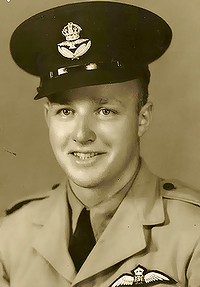
Arthur Tucker ... had seen too many comrades die in action.
ARTHUR TUCKER was one of "Jackson's Few" - the 24 pilots who in 1942 hurriedly formed Australia's first fighter squadron and held back the experienced Japanese air force in New Guinea in the 44 days between the fall of Singapore and the Battle of the Coral Sea.
This was the most terrifying time for Australia, forced to fend for itself without great power support as the Japanese forces descended upon New Guinea and began to bomb our defenceless troops in Port Moresby.
The prime minister, John Curtin, denied Spitfires by Winston Churchill, who was wedded to the "Save Europe First" policy, had prevailed on Franklin Roosevelt to send Kittyhawks, which arrived in crates at the Sydney docks.
They were hastily assembled, and Tucker was one of the young pilots who flew them to Townsville, trained for a week and then, as 75 Squadron, flew to Moresby in March 1942 to do battle with the seasoned enemy air force, based across the Owen Stanley Ranges at Lae.
Under the inspired command of "Old John" Jackson, a veteran of the Western Desert, 75 Squadron inflicted serious and disproportionate losses, in surprise bombing raids and aerial dogfights, on the enemy pilots despite their lighter and more manoeuvrable Zeros. In one scrap, Tucker downed the Japanese air ace Gitaro Miyazaki.
Although Jackson was killed in combat, the courage of "Jackson's Few" gave heart to Port Moresby's defenders. The squadron's successful strafing operations and aerial victories ensured that the Japanese advanced no further before United States air and sea power came to Australia's rescue.
Tucker was back in action in August 1942, flying combat missions in the heat of the Battle of Milne Bay, Australia's first major victory in the Pacific. Later he joined the new 86 Squadron, flying Kittyhawks, that helped dislodge Japanese forces from occupied islands.
Arthur Douglas Tucker, who has died at 89, was born in Brisbane to Leslie Tucker, who worked in retailing and was a talented musician, and his wife, formerly Edith Heap. Leslie was killed in his early 20s in a pedestrian accident when Arthur was a toddler.
The boy became an outstanding student at Brisbane Grammar and, by the age of 16, had qualified as a teacher. He cut cane to make ends meet during the Depression, then taught at outback schools until joining the RAAF at 21. After the war he studied medicine and became orthopaedic registrar at the Mater Hospital in Brisbane.
He married Nancy Gibson, who worked for the ABC in Brisbane, and she raised three children while Tucker worked as a doctor on the Snowy Mountains Scheme. He often had to be lowered in a sling down mine shafts and dam walls to reach injured workers.
As a doctor and a scientist, Tucker made remarkable contributions to industrial safety and medical knowledge. In the Snowy, he developed treatment theories that are now accepted practice, for example, the need to stabilise the injured before they are transported to hospital. He became a pioneer of workplace rehabilitation services. He even came up with an improved treatment for snakebite, using a restrictive bandage rather than a tourniquet.
For the last 20 years of his working life, Tucker was site medical officer at Lucas Heights and chief scientific officer of the Australian Atomic Energy Commission. He received international recognition for his research on the movement of fine particles in the vascular system and for his development of a method of accurately measuring lung capacity from a simple X-ray.
Humanitarianism inspired his research, through determination to make hazardous work safer for those who had to undertake it. His concern brought him into occasional conflict with the commission bosses. On his retirement in 1985 he publicly accused them of putting workers' health at risk in their obsession with promoting nuclear energy.
He worked on, through retirement, on the causes of lung disease and developed theories about the dangers to the respiratory system of air pollution in cities.
A modest man, with a laconic, self-deprecating sense of humour, he drew strength from 55 years of happy family life.
Like other sensitive war heroes, Arthur Tucker stayed silent about his experiences for many years. He had seen too many comrades die. Because he had not expected to survive, he greeted every day as an unexpected bonus. He could not abide what he considered the warmongering and racist RSL leadership of the 1950s and '60s and avoided Anzac Day parades.
It was not until 1992 that he began to open up to the Murdoch sound archives and he featured prominently in 44 Days, the documentary about Jackson's Few. Thereafter he became a stalwart presence at 75 Squadron reunions. Air Commodore Mel Huckfield has credited him with inspiring a new generation of its pilots with his qualities of "passion, intellect and candour".
A true Australian hero, Arthur Tucker never sought or obtained awards, promotion or recognition. To the very end of his life he was studying ways to make life better for others. His squadron epitaph, "Always in Flight", sums up the spirit of the man.
Arthur Tucker is survived by his wife, Nancy; their children, John, Margot and Peter; and their families, including three grandchildren.