3SQN's CANBERRA CEREMONIES
15-17 February 2026
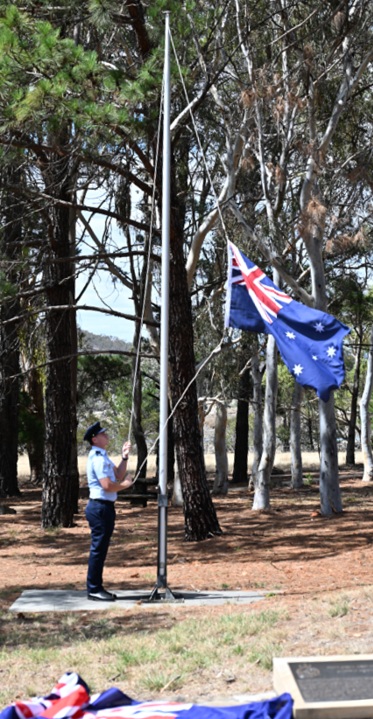
Our February Canberra Memorial events were a big success! The weather was pleasant throughout and many of the attendees, including the serving Williamtown group, were accommodated in the heritage Mercure Hotel Canberra, prompting lots of enjoyable socialising. Our formal activities were anchored around a major ceremony at the RAAF Memorial Grove on Monday 16th of February, which primarily commemorated the Founding of 450 Squadron RAAF (and the simultaneous founding of Williamtown RAAF Base) 85 years ago.

450 Squadron was 3SQN’s “twin sister”, fighting together all the way “from Alamein to the Alps”, across North Africa and through Sicily and Italy, 1942-45. The modern-day 3SQN has more than a little ‘450’ in its DNA!
The two Squadrons usually operated side-by-side and personnel and equipment flowed back and forth between them. [Not to mention many hi-jinx!] In northern Italy at the end of WW2, the two Squadrons comprised the only little island of Aussies for hundreds of miles. They were therefore challenged to many “International Test Matches” in Cricket and Rugby. [You do NOT want to play International Rugby against the bloodthirsty Maoris of the NZ Division!]

The Monday Memorial Grove ceremony was also ideal for commemorating the Centenary of 3SQN RAAF’s first fatal air-crash, which occurred in February 1926 at the Old Canberra Aerodrome (where the modern suburb of Dickson ACT now stands). The year 2026 also marks 3SQN's 110th birthday since its foundation in WW1 and the 10th Anniversary of the squadron's last "Hot War" action in Iraq/Syria, "Operation OKRA".

An impressive serving group of ten personnel from Williamtown supported all of the ceremonial activities and admirably represented the RAAF at the Formal Lunch - not to mention in the Bar after work as well!
The group also respectfully visited the graves of the air-crash victims from 1926, plus two other significant 3SQN graves in the historic St Johns Churchyard – Flying Officer EWEN (killed in 1927 during the Royal flypast at the opening of old Parliament House - amazingly!) and Wing Commander Bobby GIBBES, 3SQN’s famous desert leader from WW2, who is buried beside his Canberra pioneer ancestors.
A real highlight of the RAAF participation was the ‘Last Post’ Ceremony on the Monday evening at the Australian War Memorial. 3SQN LACW Chloey SHALLUE starred in that presentation, doing a great job narrating a RAAF memorial story that has several elements of shocking tragedy. [AWM Video – the ceremony starts at the 5:35 mark.]
On Tuesday morning the 17th, the two Associations were able to usher the RAAF “young ones” into the Aladdin’s Cave of the AWM Archives Bunker. The AWM Curators proudly showed us many 3SQN-related items - paintings, photographs, documents and technology - from their huge collection not normally on public display. A very memorable experience!
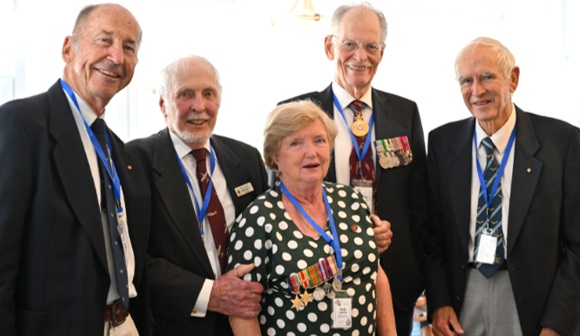
3SQN Assn members included: former COs Johnny HALY [Operation OKRA leader, ten years ago] and Darren CLARE [F-35 pioneer]; Julie MORSE [daughter of Bobby GIBBES] & Richard MORSE; Paul CALLANDER & Heather CALLANDER [who travelled from Perth; Paul is the grandson of one of the 1926 3SQN air-crash victims]; Daniel CREAMER; Mac COTTRELL; Vicki CRIGHTON; James OGLETHORPE; Wayne BEATTIE [Assn. Wreathlayer – AWM]; Malcolm ROXBOUGH; Kylie JACKSON; Mike MATTERS; Trevor BRADLEY [Assn. Wreathlayer at the Memorial Grove]; Neil SMITH & Maria SMITH; Annette HALES and Denis MITCHELL.
- And certainly not forgetting our hard-working and artistic photographer, Dom O’DONNELL!


Memorial Grove KEYNOTE SPEECH by our member JOE IERVASI .
"85th ANNIVERSARY of FOUNDATION of 450 SQN RAAF."
Ladies and gentlemen, today we honour one of the most distinguished units in Australia’s wartime history — No. 450 Squadron of the Royal Australian Air Force, the proud “Desert Harassers.” Their story is one of courage, endurance, and the unmistakable Australian spirit that carried them through some of the toughest campaigns of the Second World War.

In February 1941 – ten months before the start of war in the Pacific – the fate of Europe hung in the balance. Nazi Germany had overrun much of the continent, Britain stood alone under the Blitz, and in North Africa Rommel’s Afrika Korps threatened to break the Allied line.
Air power was desperately needed.
Consequently, the Commonwealth’s Empire Air Training Scheme had been established; whereby Australia, Canada, South Africa, Southern Rhodesia and New Zealand would undertake training of aircrew in skies free from the threat of enemy incursion. Under Article XV of the Empire Air Training Scheme, these aircrew would subsequently be formed into their own national squadrons to support the RAF. In practice, each unit included aircrew from various Commonwealth nations, but was commanded by one nation.
For its part, Australia agreed to provide trained personnel for a projected eighteen squadrons, being numbered between 450 and 467. Thus, 450 Squadron became the first of these units. In addition to sending men overseas for aircrew training, the RAAF set about improving its own air- and ground-training schools throughout Australia.
From the beginning 450 Squadron forged a close bond with No.3 Squadron RAAF. When 450 Squadron arrived in the Middle East with ground crew but no pilots, 3 Squadron’s experienced aircrew flew the aircraft while 450 Squadron maintained them. That partnership carried them through the Syrian campaign and grew into a lifelong bond. Even after 450 Squadron received its own pilots, the two units continued to operate side-by-side, sharing airfields, missions, dangers, and a uniquely Australian sense of humour.
From the outset, the Squadron was shaped by remarkable leadership. Its first commanding officer, Gordon Steege, was already one of Australia’s early fighter aces — calm, capable, and fiercely protective of his men. Four years later, its final wartime commander, Jack Doyle, would lead the Squadron through the last brutal stages of the Italian campaign. Between them, Steege and Doyle bookend the Squadron’s journey: one establishing its character, the other carrying that spirit through to Victory.

Their connection deepened within 239 Wing of the Desert Air Force — a fast moving, hard hitting fighter-bomber formation renowned for its low-level operations. Together with Nos. 112, 250, and 260 Squadrons of the RAF, and No.5 SAAF, the Australians supported the Eighth Army from the deserts of North Africa through to Sicily and the long, grinding advance up the Italian peninsula. They moved together, fought together, and looked after one another in a way that veterans remembered for the rest of their lives.
By early 1942, 450 Squadron had its own pilots and its own aircraft — the rugged Curtiss P-40 Kittyhawk. It was during this period that the Squadron earned its famous nickname. German propagandist “LORD HAW HAW” sneered at them as, “those Australian desert harassers.” The men embraced the insult instantly, wearing it as a badge of honour.

Operating as part of the Desert Air Force, the Squadron became known for its speed & mobility. In one fortnight in November 1942, they shifted airfields six times — packing up, relocating, and resuming operations almost overnight. This ability to stay close to the front made their support to the Eighth Army immediate and decisive. It also demanded extraordinary resilience from the ground crew, who often arrived at a new strip before the dust had settled, preparing aircraft for combat while the sounds of the front echoed just beyond the horizon.
Their combat record in the desert was remarkable. Over just 15 months, 450 Squadron achieved 16 enemy aircraft listed as “probably destroyed” and 27 damaged in the air. On the ground they destroyed or damaged 93 aircraft and an astonishing 584 motor transports. During this desert phase alone, members of the Squadron received eight Distinguished Flying Crosses and five Distinguished Flying Medals — honours that reflected not only individual bravery but the relentless operational tempo that defined the Desert Harassers.
As the war moved north, the Squadron followed the Allied advance into Sicily and Italy, flying close air support in a campaign marked by mountains, rivers, and fortified defensive lines. The conditions were harsh and the work unrelenting.

It was during this period that Jack Doyle — who would become the Squadron’s last wartime commanding officer — offered some of the clearest insights into life within 239 Wing. In his Australian War Memorial interview, he described the Wing as a family forged by constant movement and constant danger. They shifted airfields so often that, as he put it, “you never really unpacked,” and “flying so close to the deck that you could feel the slipstream kicking up dust. It was dangerous, exhausting flying, and it demanded absolute trust between pilots and ground crew.”

The spectacularly
damaged wing-root and tail of
SQNLDR Jack DOYLE's
450 Squadron Kittyhawk Mark IV, FX529, after he had
landed it back at Cervia, Italy
on 18/4/45. Hit
by anti-aircraft shells during a ground-attack sortie over
the 8th Army Front, it required magnificent flying-skill from
Jack to bring it back safely. [Imperial War Museum CNA
3543.]
Doyle said the Australians, South Africans, and British, “lived on top of each other,” and because of that, they fought with complete confidence in one another. Humour was essential — “if you didn’t laugh, you’d go mad” — and the ground crew, he said, could, “make an aircraft fly when it had no right to.” His memories capture the spirit of 239 Wing: fast, fearless, and held together by mateship.

Yet even in the hardest moments, the Australians found ways to lift spirits. According to the recollections of 239 Wing veterans — stories preserved by both the 3 Squadron and 450 Squadron Associations — the Wing once operated near the Italian town of Agnone, where the Germans had partly blown-up the local railway station during their retreat. Most people would have seen a ruined building. The Australians saw potential.
They cleared out the rubble, patched the holes, hung up signs, and proudly opened what they called the
‘Agnone Aerodrome Railway Refreshment Rooms’. - Someone even chalked up a timetable that read:
“Trains: none today, none tomorrow, none expected.”
It was known as the only railway station in Italy where the trains never ran, but the bar never closed! In the middle of a brutal campaign, it became a small sanctuary — a reminder that humour, camaraderie, and the Australian spirit endured even in war.
By 1945, the Squadron began converting to the P-51 Mustang, but the war ended before they could take the new aircraft into combat.
In August 1945, after four and a half years of continuous operations, No. 450 Squadron was disbanded.
When 450 Squadron had first sailed from Sydney in 1941, it did so with just 279 men — a small group heading into an uncertain war. Over the course of the conflict, more than 800 men would serve with the Squadron, rotating through as the fighting wore on. They worked in heat, dust, mud, and snow, often with limited tools and under constant pressure. Their skill kept the Kittyhawks flying, and their resilience kept the Squadron fighting.
Forty nine men paid the ultimate sacrifice — a solemn reminder of the cost carried by a unit that never faltered in its duty.
Ladies and gentlemen, the men of No. 450 Squadron RAAF were more than names on a roll or figures in a history book. They were young Australians who carried hope, humour, and determination into some of the hardest fighting of the war. They stood by each other, they lifted each other, and they never forgot who they were or what they represented. Their courage bought the Peace we live in. Their spirit still speaks to us. May we REMEMBER THEM not only for what they did, but for who they were — and may their example remind us of the strength that lies in service, in mateship, and in the quiet resolve to do what is right.